funding announcement
How to Announce a Funding Round: A PR Playbook for Startups
By Sunny Goyal · · 12 min read
To announce a funding round, give one reporter an embargoed exclusive (or a small group an embargoed briefing) about four weeks out, publish a press release and a founder blog post at the embargo time, and post on LinkedIn and email customers the same morning. Reporters need the amount, lead investor, use of funds, and real traction. Start planning six weeks ahead.
A funding round is one of the few moments when a Seed to Series B startup has news that reporters, candidates, customers, and future investors all care about at once. Handled well, it produces a credible article, a spike in inbound interest, and third-party pages that describe your company accurately for years. Handled badly, it produces a press release nobody reads and a Form D filing that a reporter finds before you are ready.
What should a funding announcement include?
A funding announcement should include five things: the round and amount, who led it, what the money is for, proof of traction, and why the market matters now. A reporter who cannot get all five usually passes or writes a two-line brief.
| What reporters need | What to prepare | Example (use your real facts) |
|---|---|---|
| Round and amount | Round name, total raised, total to date | $8M Series A, $11M total raised |
| Lead and notable investors | Lead firm, partner name, a quote from the partner | Led by [Firm], with participation from [Firms] |
| Use of funds | Two or three specific uses, with numbers where possible | Double engineering team to 30; open Austin office |
| Traction | Numbers you are willing to publish | Revenue growth rate, customers, usage, retention |
| Why now | The market shift the company is betting on | New regulation, cost change, behavior shift |
| Founder story | Why this founder, why this problem | Ran restaurant payroll for 8 years before building this |
| Assets | Photos, logo, product images, customer contact | High-resolution founder photo, landscape and portrait |
Traction is where most founders hesitate. You do not have to share revenue, but you need something concrete: customer count, growth multiple, transactions processed, or a named customer on the record. “Strong growth” will not survive an editor. Muck Rack’s State of Journalism 2026 found that journalists value access to relevant sources and original research or data in a pitch; a funding story is no exception.
Before any of this, sharpen the one-sentence description of what you do. If it takes a paragraph, reporters will write their own version. Our guide to writing a unique selling proposition is a quick way to pressure-test it.
Exclusive vs broad announcement: which should you choose?
Choose an exclusive when one outlet reaches exactly your audience and your news is strong enough for a full story there; choose a broad embargoed announcement when the raise is large, your audience spans several beats, or trade coverage matters more than one headline.
| Exclusive | Broad embargoed announcement | |
|---|---|---|
| How it works | One reporter gets the story first, under embargo | Several reporters get the same news under one embargo |
| Best for | Seed and Series A with a strong story angle | Larger rounds, well-known investors, multiple audiences |
| Typical result | One in-depth article, then pickup | Several shorter articles on the same day |
| Risk | Reporter passes late and you lose time | Coverage is thinner and more similar |
| Your control | High: one relationship to manage | Lower: more people hold the news |
A common hybrid: offer an exclusive to a top-choice outlet, then after it publishes, send the press release to trade and regional reporters as a “confirmed news” pitch. Our founder PR launch playbook walks through this sequence step by step, including how to score a reporter list. Tell the exclusive reporter about this plan up front.
A reporter will not take an exclusive on news that is already public. If your Form D is filed and visible, or an investor has posted about the deal, the exclusive is weaker or gone. Which brings us to timing.
The funding announcement timeline: T-6 weeks to T+2 weeks
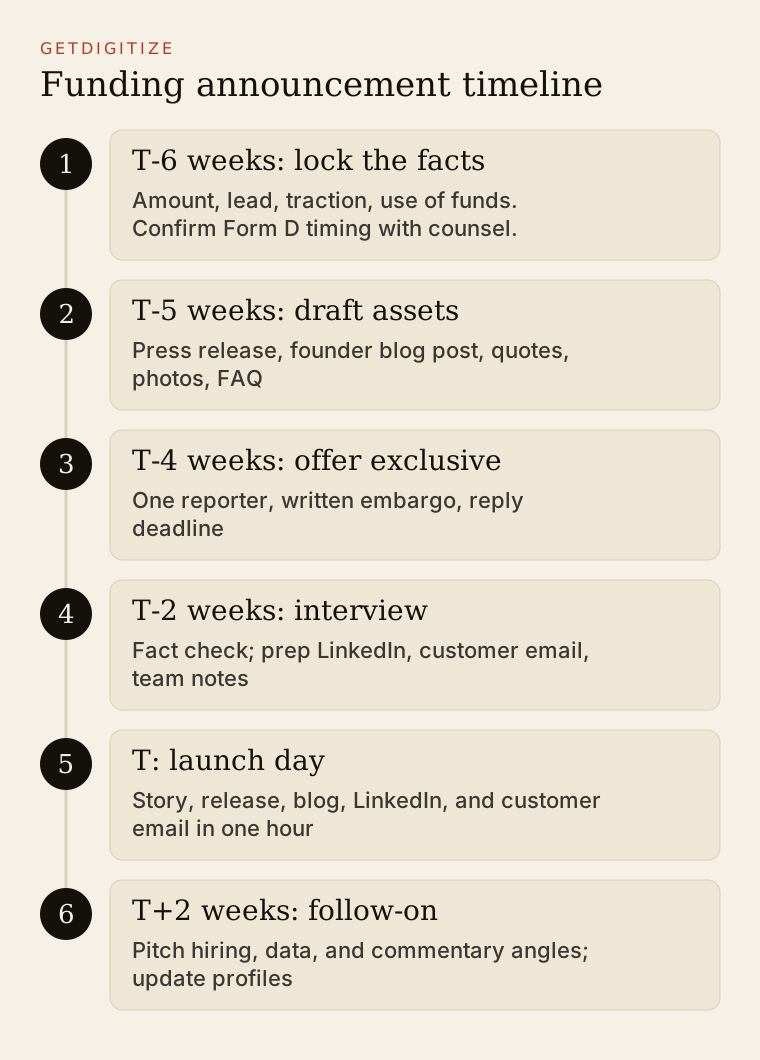
Work backward from announcement day (T). This timeline assumes the round has closed or is contractually committed, which you should confirm with counsel before briefing anyone outside the deal.
| When | What happens | Owner |
|---|---|---|
| T-6 weeks | Agree the facts you will publish (amount, lead, traction). Confirm Form D timing with counsel. Choose exclusive or broad. | Founder, counsel |
| T-5 weeks | Draft the press release, founder blog post, FAQ, and investor quote. Book a founder photo shoot. | Founder, PR |
| T-4 weeks | Build the reporter list. Send the exclusive pitch with an embargo and a reply deadline. | PR |
| T-3 weeks | If the exclusive is accepted, schedule the interview. If declined, go to choice two. | PR |
| T-2 weeks | Interview and fact check. Prepare the LinkedIn posts, customer email, and team talking points. | Founder, PR |
| T-1 week | Brief investors on the embargo time and ask them to hold posts. Update your website, careers page, and newsroom page in draft. | Founder |
| T (launch day) | Story publishes at embargo time. Press release goes live. Blog post, LinkedIn, customer email, and investor posts follow within the hour. | Everyone |
| T+1 to T+3 days | Pitch trade and regional reporters with the published story as proof. Thank the reporter. | PR |
| T+2 weeks | Pitch follow-on angles: hiring, product, data, founder commentary. Update company profiles and directories. | PR, founder |
How does an embargo work?
An embargo is an agreement that a reporter can receive news early on the condition that they do not publish before a set date and time. It gives the reporter time to interview and write properly, and gives you a coordinated launch.
Embargo mechanics that protect you:
- Ask before you send. Pitch the story in general terms, and share the details only after the reporter agrees to the embargo in writing (a reply email is enough).
- State the exact time and time zone. “Embargoed until Tuesday, October 14, 6:00 am ET.”
- Put “EMBARGOED” at the top of the press release and in the email subject.
- Keep the circle small. Every investor, advisor, and employee who knows is a leak risk. Brief them on the time too.
- Have a plan if it breaks. If a story publishes early, release everything immediately and tell the other reporters.
Copy-paste exclusive pitch with embargo:
Subject: Exclusive offer: [Company] raises $[X]M [round] led by [Investor]

Hi [First name],

Given your coverage of [specific topic or recent article], I'd like to offer
you the exclusive on [Company]'s $[X]M [round], led by [Investor], embargoed
until [day, date, time, time zone].

The story: [one sentence on the problem and why now].
Traction: [one or two numbers you will publish].
Use of funds: [two concrete uses].

Available for interview: [Founder name, title] and [Investor partner name].
We can also share [customer contact / data / product images].

Could you let me know by [date] whether you'd like it? If you agree to the
embargo, I'll send the full release and assets right away.

[Name]
[Title, Company] | [phone]
For more on the structure and the follow-up rules, see our full guide to pitching a journalist.
Press release vs blog post: do you need both?
Yes, usually. The press release is a factual reference for reporters, directories, and databases; the founder blog post tells the story in your voice for customers, candidates, and future investors. They do different jobs.
Press releases still matter to newsrooms. In Cision’s 2025 State of the Media survey of more than 3,000 journalists, 72% cited press releases as the most useful resource PR teams can offer. Whether paid wire distribution is worth it is a separate question, covered in does press release distribution still work. For most Seed and Series A rounds, posting the release on your own newsroom page and sending it directly to reporters is enough.
A funding press release skeleton:
EMBARGOED UNTIL [DATE, TIME, TIME ZONE]

Headline: [Company] Raises $[X]M [Round] to [plain-language outcome]
Subhead: Round led by [Investor]; funds will [use 1] and [use 2]

[CITY, Date] [Company], [one-line description], today announced $[X]M in
[round] funding led by [Investor], with participation from [Investors].
The round brings total funding to $[Y]M.

Paragraph 2: The problem and why now, with one sourced fact.
Paragraph 3: Traction you will publish.
Paragraph 4: Founder quote (a view on the market, not "we're thrilled").
Paragraph 5: Investor quote (why they backed this team).
Paragraph 6: Use of funds, hiring plans, and where to see open roles.

About [Company]: [three sentences, consistent with your website].
Media contact: [name, email, phone]
The blog post can be more personal: why you started, what you learned raising, what you will build next, and a link to open roles. Keep facts identical across both documents; reporters and AI systems both notice contradictions.
What legal checks come before a funding announcement?
Check two things with your securities counsel: when your Form D will be filed, and whether any announcement could count as general solicitation while the offering is still open. This is not legal advice, but these are the questions founders most often forget to ask.
Form D is public. According to the SEC’s guidance on filing a Form D notice, a company must file within 15 days after the first sale of securities, and the date of first sale is when the first investor is irrevocably contractually committed to invest. The filing is made on EDGAR, where it is publicly accessible. Reporters and data services watch these filings, so your raise can surface before your announcement. Align your timeline with the filing date.
Open offerings have limits. The SEC notes that Rule 506(b) prohibits using general solicitation to market the securities, and lists public websites and newspaper and magazine advertisements among the examples. The safest practice is to announce after the round has closed, and to have counsel review the release if any part of the round is still open.
How should you handle LinkedIn, customers, and your team?
Tell your team first, customers second, and the public at the embargo time, so nobody important learns the news from TechCrunch.
Team (T-1 day or morning of): a short all-hands with what you raised, why, what changes, and what does not. Give everyone the approved one-liner and ask them to reshare, not rewrite.
Customers (launch morning): a short email from the founder. Customers mainly want to know the product will get better and the company will be around.
Subject: Our news today, and what it means for you

Hi [First name],

Today we announced a $[X]M [round] led by [Investor]. You're one of the
reasons it happened, so I wanted you to hear it from me.

What it means for you: [two concrete changes, e.g. faster support hours,
a feature on your wishlist, a new integration by Q2].
What won't change: [pricing, your account team, etc., if true].

Thank you for trusting us early.
[Founder name]
LinkedIn (launch hour): the founder posts in their own voice, and the company page reshares. Muck Rack’s 2026 survey found 58% of journalists trust LinkedIn to treat journalistic content fairly, and it is where investors and candidates look. A post structure that works: one line with the news, two or three lines on why the problem matters, one line thanking investors and the team, and a link to the article (put links in the first comment if you prefer). Ask investors to post within the same hour and tag the company.
How do you turn a raise into ongoing coverage and AI visibility?
Treat the raise as the start of a coverage cycle, not the end. The funding story gives reporters a reason to trust you; the follow-on stories are where you build a point of view.
Follow-on angles for the next 90 days:
- Hiring story: for regional business press, if you are adding jobs in a specific city.
- Data story: anonymized insights from your product, pitched to trade outlets.
- Founder commentary: a view on the market shift you raised money to pursue, for reporters covering that trend.
- Podcasts and bylines: the raise makes bookers and editors take the founder seriously. See our guide to podcast guesting for founders.
Then update the pages that AI search engines rely on. When someone asks ChatGPT or Perplexity “who are the leading startups in [category],” the answer draws on third-party articles, directories, and your own site. On launch week:
- Publish the release and coverage links on a newsroom page built to be cited.
- Update your About page, Crunchbase, LinkedIn company page, and any databases with identical funding facts and one consistent company description.
- Make sure founder and company entity details are consistent, which also helps with a Google Knowledge Panel.
What this means for founders (and when it does not apply)
Seed to Series B founders get the most from this playbook. A Seed round with a sharp story can land a trade exclusive; a Series A or B with a known lead can support a national exclusive plus broad trade coverage. If the round is small or the story thin, a founder blog post, LinkedIn post, and newsroom update may be the right scale, and you save the reporter relationships for a stronger moment.
D2C brands raising a round should add a consumer angle (a new category, retail expansion, a founder story) since business reporters are not their only audience.
Multi-location operators rarely announce venture rounds, but the same mechanics work for a private equity partnership, an acquisition, or an expansion into new markets: regional business journals are the exclusive target.
Your next step: open a document, fill in the “what reporters need” table above with facts you are willing to publish, and set your T date six weeks out. If you want help running the exclusive and the launch-day coordination, our founder PR team runs funding announcements as a Launch Campaign.
Frequently asked questions
When should a startup announce its funding round?
Announce after the round has closed or investors are contractually committed, and time it with counsel around your Form D filing, which becomes public on EDGAR. Plan about six weeks ahead so you can offer an exclusive about four weeks out. Tuesday through Thursday mornings are common launch slots, and you should avoid major news days in your sector.
Should I disclose how much we raised?
Yes, if you can. The amount and the lead investor are the core facts of a funding story, and many reporters will not cover a raise without them. If your Form D filing will be public anyway, withholding the amount rarely helps. You can decline to share valuation, revenue, or specific terms; just say so plainly rather than being vague.
Is it better to give a funding story to TechCrunch or a trade publication?
Choose the outlet your buyers, candidates, and next investors actually read. A national tech outlet brings broad visibility; a trade publication in your category often produces a longer story and reaches buyers directly. Many startups offer the exclusive to one and send confirmed news to the other tier immediately after publication.
What if a reporter breaks the embargo?
Publish everything immediately: the press release, blog post, and social posts. Then tell the other embargoed reporters what happened so they can publish too. Afterward, raise it calmly with the reporter or their editor. Embargo breaks are uncommon when terms are agreed in writing, with an exact date, time, and time zone, before details are shared.