gift guides
How to Get Your Product Featured in Gift Guides
By Maya Patel · · 11 min read
To get featured in gift guides, pitch the right commerce editor months before the guide publishes, with a product that is easy to buy through an affiliate link, a clear price, strong images, and a one-sentence reason someone would give it as a gift. Gift guides are shopping content: editors choose products readers will click and buy, so you win by making that choice easy.
For a D2C brand, one placement in a guide at The Strategist, Apartment Therapy, or Allure can bring a burst of sales, a quote for your product page, and a durable third-party mention that search engines and AI tools can find. This guide covers the calendar, the outlets and editors, why affiliate programs decide so much, exactly what to send, a pitch template you can copy, and how to make each placement count long after December.
When should you pitch holiday gift guides?
Pitch long-lead print magazines in June and July, national online outlets in August, and digital shopping editors through September, with follow-ups in October. Most top-tier guides are planned well before they publish, and late pitches often arrive after a writer’s list is already full.
Muck Rack’s guide to pitching holiday gift guides quotes freelance writer Alesandra Dubin saying that around Labor Day she is already done with “last-minute” gift guide pitches. Treat September as the tail end of the window for national outlets, not the start.
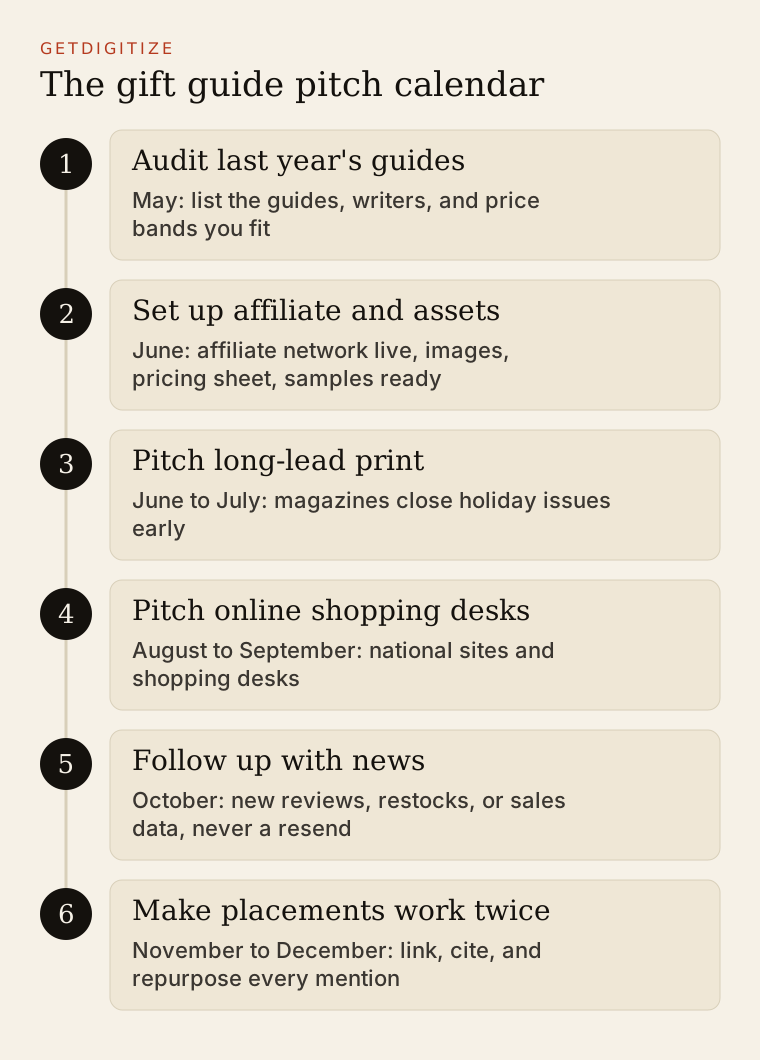
A gift guide calendar you can copy
| Month | Who you pitch | What you do |
|---|---|---|
| April to May | Nobody yet | Audit last year’s guides; list writers, outlets, price bands, and categories you fit |
| May to June | Editors and creators you want to know you | Seed product so they have used it before the season (see product seeding for D2C brands) |
| June to July | Long-lead print magazines | Pitch holiday issues; send samples on request |
| August | National online outlets | Pitch gift guide writers and shopping desks with full assets |
| September | Digital commerce editors, freelancers | Pitch remaining guides; send samples fast |
| October | Short-lead outlets, newsletters, creators | Follow up with new information; pitch creator gift lists |
| November | Local TV, regional outlets | Pitch local angles and last-minute guides |
| December | Deal sites, last-minute roundups | Offer shipping cutoffs, gift cards, digital gifts |
The same logic applies to other gifting moments: Mother’s Day and Father’s Day guides are planned in late winter and early spring, and graduation and wedding guides in spring.
Which outlets and editors write gift guides?
Gift guides are written by commerce teams (sometimes called shopping, deals, or reviews desks) and by the freelancers who write for them, not usually by the news reporters at the same outlet. Target the person whose byline is on last year’s guide.
Work through four tiers:
- National commerce publications. The Strategist, Wirecutter, and the shopping sections of large magazines and newspapers publish dozens of guides by recipient (“for the host,” “for new parents”), by price (“under $50”), and by category.
- Vertical and lifestyle outlets. Allure for beauty, Apartment Therapy for home, and category-specific titles for food, fitness, pets, and parenting. These are often the best fit for a focused D2C brand.
- Freelancers. Many guides are written by freelancers who write the same kind of roundup for several outlets each season. One good relationship can mean several placements.
- Newsletters, creators, and local media. Creator gift lists and local TV segments run later in the season and are more open to newer brands.
The fastest research method: search last year’s guides in your category, open 30 to 50 of them, and log the writer, outlet, guide angle, price range, and whether the products linked to Amazon, a retailer, or the brand site. That sheet becomes your pitch list and tells you which price band and retailer you need to fit.
Why do affiliate programs matter to commerce editors?
Affiliate programs matter because affiliate commissions are how most commerce content pays for itself. When an editor links a product and a reader buys, the outlet earns a percentage. A product with no affiliate link earns the outlet nothing, so it competes at a disadvantage against a similar product that does.
Writers say this plainly. In the same Muck Rack piece, freelance writer Jill Schildhouse notes that if a product is not on an affiliate network such as Amazon, ShareASale, Impact, or CJ, the chances of inclusion in a holiday gift guide are “slim to none.” A September 2026 guest post by Sarah Karger in Alice Dubin’s newsletter on the affiliate lesson every publicist needs for holiday explains why editors often link to Amazon over a brand’s own site: publishers watch earnings per click, and a retailer that converts well (and pays on the whole basket) earns more per click than a site that does not.
What that means for you:
- Join at least one major affiliate network before you pitch, and list the product with a retailer that editors already link to if you can.
- Check your own site’s conversion. If shoppers who click from a guide bounce off a slow product page, the editor’s earnings drop and your next pitch gets a colder read.
- Offer a competitive commission for the season, and say so in the pitch.
- Keep stock and links live. A guide that sends readers to an out-of-stock page costs the editor money.
Affiliate links also carry disclosure duties for the publisher. The FTC’s Endorsement Guides FAQ says that websites earning commissions from links need a clear disclosure near the link. That is the outlet’s job, but it is a reminder that gift guides are commercial content, and editors take the business side seriously.
What should you send a gift guide editor?
Send everything an editor needs to include your product in one email, without a second round of questions. Gift guide writers juggle hundreds of pitches in a season, so completeness is a competitive advantage.
| Asset | What to include | Why it matters |
|---|---|---|
| Price | Exact retail price, and any holiday bundle price | Guides are sorted by price band |
| Purchase links | Brand site plus any retailer (Amazon, Target, Nordstrom, Sephora) | Editors pick the link that converts best for their audience |
| Affiliate details | Network name, commission rate, program ID | Often the deciding factor |
| Images | High-resolution product shots on a white background, plus one lifestyle shot, via a single link | Many guides use a silhouetted product image |
| Gift angle | One sentence on who it is for | Guides are organized by recipient |
| Samples | Offer to send, and ship within days | Many editors test before including |
| Proof | Review count and average rating, or a notable press mention | Helps an editor trust a newer brand |
| Shipping cutoffs | Last day to order for delivery by the holiday | Needed for late-season guides |
Differentiation matters too. Muck Rack’s guidance lists pricing, sustainable materials, inclusive sizing, and diverse colorways as the kinds of specifics that make a pitch stand out. If you have not sharpened that line yet, work through how to write a unique selling proposition before you write a single pitch.
How do you write a gift guide pitch? (template)
Write a short email with the gift angle in the subject line, the product and price in the first sentence, and every asset in the body. Our guide on how to pitch a journalist covers general pitching; gift guide pitches are more like a product listing than a story pitch.
Subject: Gift idea for [recipient type] under $[price]: [product name]
Hi [first name],
I saw your [year] guide, “[title of last year’s guide],” and wanted to share an option for this year’s version.
[Product name], $[price]: [One sentence on what it is and why it makes a good gift for this recipient.]
- Buy: [brand site link] | [retailer link]
- Affiliate: [network], [commission]% ([program ID])
- Images: [one link to high-res white background and lifestyle shots]
- Why it stands out: [one specific differentiator, e.g., refillable, inclusive shade range, made in small batches]
- Proof: [e.g., 1,200 reviews averaging 4.7 stars] or [notable press mention]
- Ships by: [holiday shipping cutoff]
Happy to send a sample to try first. Just reply with the best address.
Thanks, [Name], [title], [brand], [phone]
Keep it under 150 words. Do not attach large files; link them. Pitch one writer per outlet at a time, and personalize the first line with a real guide they wrote.
How to follow up
Follow up once, about a week later, with new information rather than a resend. Muck Rack’s writers recommend sharing something fresh, like new popularity data or review counts. A restock after a sellout, a new colorway, or a notable press mention all count. If there is no reply after the second touch, move on and try that writer again next season.
How do you make gift guide placements count for search?
Treat every placement as a long-lived earned media asset, not a one-week sales spike. Gift guides often get updated and republished each year, and they are exactly the kind of third-party page that search engines and AI assistants use to answer “best gifts for” queries.
Do these five things with every placement:
- Log it with the URL, date, writer, and link type in a coverage tracker.
- Link to it from a press or “as seen in” page on your site, and quote the editor’s line on your product page. Our guide to testimonials in digital marketing covers how to present third-party praise accurately.
- Thank the writer and send them any product news before next year’s update.
- Keep the product live at the same URL and price band so the guide stays accurate when it is refreshed.
- Repurpose it in email, paid social, and creator briefs (“featured in [outlet]‘s gift guide”).
On the AI side, a named mention in a trusted gift guide is the kind of brand mention AI search tools draw on when they answer shopping questions. We explain why in brand mentions vs backlinks for AI citation. A guide that mentions you without a link still has value, even if it passes no traditional link equity.
How D2C brands should approach gift guide season
For a D2C brand between $500K and $10M a year, gift guides are one of the most reliable ways into top-tier editorial coverage, because the bar is “is this a good product at this price for this person,” not “is this news.” That favors focused brands with a clear gift angle.
A realistic plan for a small team:
- Pick two or three hero products with the clearest gift angles and price points, rather than pitching the whole catalog.
- Build a list of 60 to 100 writers from last year’s guides in your categories.
- Set up the affiliate program and assets by early summer, then pitch in waves from June through September.
- Seed editors early so your product is familiar by the time they build lists.
- Track results by placement, affiliate clicks, and sales in the weeks after each guide goes live.
If you would rather hand off the list building, pitching, and follow-up, our media relations team runs gift guide campaigns for consumer brands, and our page for D2C brands shows how gift guides fit with seeding and creator work. Either way, start this week by opening last year’s guides in your category and writing down the first 20 bylines.
Frequently asked questions
How far in advance do you pitch holiday gift guides?
Start pitching long-lead print magazines in June and July and national online outlets in August. One freelance gift guide writer told Muck Rack she is done with even last-minute pitches around Labor Day, so treat September as the tail end of the window for top outlets. Short-lead outlets, newsletters, local TV, and creator lists stay open into October and November.
Do you need an affiliate program to get into gift guides?
Not always, but it helps a great deal. Commerce editors earn revenue when readers buy through affiliate links, and freelance writer Jill Schildhouse has said products without a program on a network like Amazon, ShareASale, Impact, or CJ have slim chances of inclusion. Set up at least one major program, share commission details in the pitch, and make sure your product page converts.
Do you have to pay to be in a gift guide?
No, editorial gift guides at reputable outlets do not charge for inclusion; editors choose products on merit and earn through affiliate commissions. Some outlets and creators also sell sponsored gift guides, which are advertising and must be labeled as such. Know which one you are being offered, and budget separately for paid placements if you choose to use them.
What images do gift guide editors want?
Editors usually want high-resolution product images on a clean white background, plus one lifestyle image, shared through a single download link. Many guides use a uniform silhouetted product shot, so the white-background image is the one that gets used most. Name the files clearly with the product name and include credit information if a photographer requires it.
Should you send samples with a gift guide pitch?
Offer samples in the pitch rather than sending them unannounced. Many editors test products before including them, so be ready to ship within a few days of a request. Brands that seeded editors months earlier have an advantage, because the editor already knows the product when the list is being built.