podcast guesting
Podcast Guesting for Founders: How to Get Booked and Get Value
By Priya Mehta · · 13 min read
A podcast guesting strategy is a repeatable system for getting a founder booked on shows their buyers and investors already listen to, then turning each episode into clips, posts, and quotes. It matters because a 40-minute conversation builds more trust than a 600-word article, and because episodes now live as transcripts and video that search engines and AI assistants can read and cite.
A strategy means you pick shows on purpose, arrive with material, and leave with a month of content per recording.
Why do podcasts matter for founders?
Podcasts matter for founders because they give a buyer, candidate, or investor long, uninterrupted time with your thinking, which no ad or press quote can match. A listener who hears you reason through a hard problem for 30 minutes forms an opinion about your judgment, not just your product.
Three shifts make guesting more valuable now:
- The audience is large and mainstream. Edison Research’s Infinite Dial 2025 found that 55 percent of Americans age 12 and older are monthly podcast consumers, and 51 percent have watched a podcast.
- Podcasts became video. YouTube reported more than 1 billion monthly active viewers of podcast content as of January 2025, and Edison’s data names YouTube the service used most often for podcasts in the US. A guest spot is now also a video asset with your face on it.
- Episodes became text. Apple added automatic transcripts to Apple Podcasts in March 2024, searchable by phrase. Between those transcripts, YouTube captions, and show notes, what you say on a show turns into indexable words attached to your name.
Founders underrate that third point. When a Seed-stage founder explains their category clearly on five well-chosen shows, those transcripts and show notes become third-party text describing the company in the founder’s framing, the kind of material answer engines draw from when someone asks “who is building X?” We cover the mechanics in our guide on how to get cited by ChatGPT and Perplexity.
How does podcast guesting compare to other founder PR channels?
Podcast guesting sits between bylines and press coverage: more reach than a byline, more control than an interview with a reporter, and much more time with the audience than either.
| Channel | Time with audience | Your control of message | Effort per placement | Best for |
|---|---|---|---|---|
| Podcast guest spot | 20 to 60 minutes | High (you talk, host guides) | Medium: pitch plus 1 hour recording | Trust, founder voice, repurposable content |
| Contributed byline | 3 to 6 minute read | High (editor edits) | High: drafting and revisions | Authority on one argument |
| Press interview | A quote or paragraph | Low (reporter frames) | Low to medium | Credibility, launches, funding news |
| LinkedIn post | Seconds to a minute | Full | Low | Frequency, staying visible |
Podcasts let a founder be most fully themselves at a reasonable time cost. They pair well with written thought leadership, which we cover in how founders land bylines that matter, and with news moments like a raise or a product launch.
How do you find the right podcasts to pitch?
You find the right podcasts by starting from the listener, not the download count. The question is “who do I need to hear this, and what do they already listen to?” A 2,000-listener show hosted by an operator your buyers follow beats a 200,000-listener general business show where nobody fits your ICP.
Build a target list in three tiers
- Tier 1, buyer shows. Hosted by or for the people who sign your contracts. For a vertical SaaS founder selling to dental groups, that means practice-management and dental-business shows, not startup shows.
- Tier 2, peer and category shows. Founder, investor, and category shows that shape how your space is discussed. Good for recruiting, fundraising, and category language.
- Tier 3, stretch shows. Larger shows you pitch once you have three or four solid episodes to point to.
Aim for roughly 20 shows in Tier 1, 10 in Tier 2, and 5 in Tier 3 for your first quarter.
How to research fit quickly
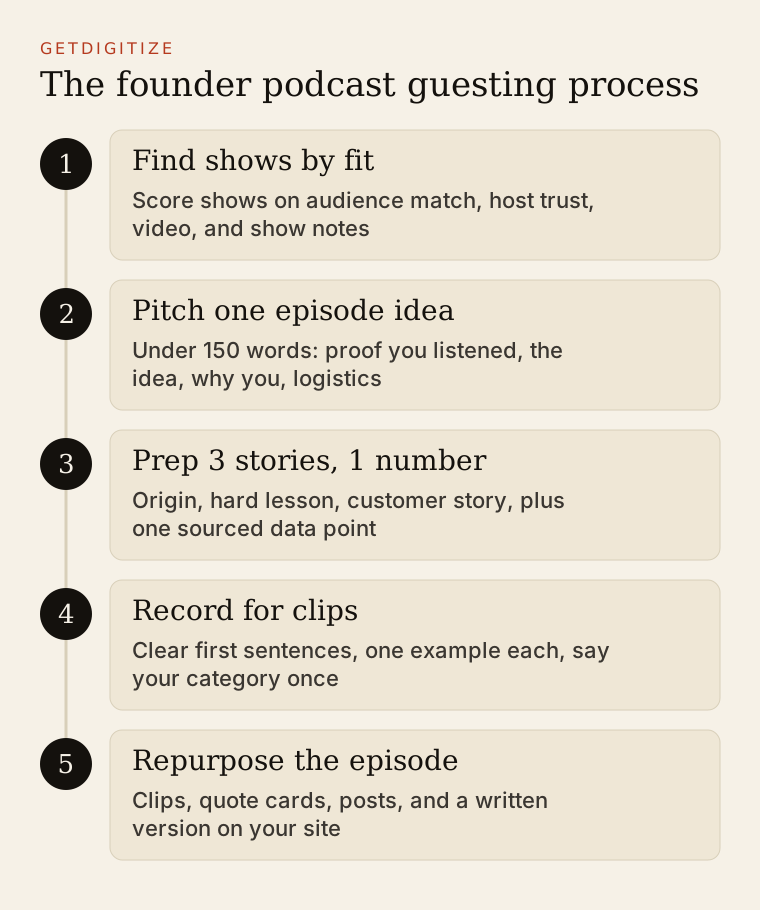
For each show, spend 15 minutes on these checks before you pitch:
- Listen to 10 minutes of two recent episodes and note the questions the host always asks.
- Read the guest list for the last six months. Are guests people your buyers respect? Has a direct competitor been on recently?
- Check that the show is still publishing; anything with no episode in 90 days goes to the bottom.
- Look at the YouTube channel and comments. Real comments from practitioners tell you more about the audience than any listener number.
- Find the booking path: a guest form, a producer’s email, or the host directly.
Podcast fit scorecard (copy this)
Score each show from 1 to 3 on each line, and pitch anything that totals 12 or more.
| Criterion | 1 | 2 | 3 |
|---|---|---|---|
| Audience match to your ICP | Loose | Partial | Direct buyers or investors |
| Host credibility with that audience | Unknown | Known | Trusted voice |
| Publishing consistency | Irregular | Monthly | Weekly or better |
| Video published (YouTube) | No | Clips only | Full episodes |
| Show notes and transcripts | None | Basic notes | Full notes with guest links |
| Guest quality, last 6 months | Mixed | Solid | Peers you want to be seen with |
The last two rows matter for AI visibility. Shows that publish full show notes, guest bios, and links back to your site create lasting, crawlable pages. Shows that publish audio only give you a good conversation and little else.
How do you pitch a podcast host and get booked?
You get booked by pitching a specific episode, not yourself. Hosts receive a steady flow of generic “our CEO would be a great guest” emails. The ones that land name a topic their audience cares about, show you listened, and make the host’s job easy.
Keep the pitch under 150 words. It should contain four things: proof you listened, the episode idea, why you are credible on it, and the logistics.
Copy-paste pitch template:
Subject: Episode idea for [Show]: [specific topic in plain words]
Hi [Host first name],
Your episode with [recent guest] on [topic] stuck with me, especially [specific point they made]. I’d like to offer a follow-up angle for your listeners.
Episode idea: [one-line title], covering [3 short bullets of what listeners learn].
Why me: I’m [name], founder of [company]. We [one concrete credential: customers, years in the field, a public milestone]. I can share [the data point or story you will bring].
I can record any time in the next three weeks and will share the episode with our [audience size or channel] once it’s live. Happy to send a one-page guest sheet.
[Name]
A few rules we apply to every podcast pitch:
- One show, one pitch. Personalize the first two lines every time.
- Offer three angles only if asked. The first email carries one clear idea.
- Follow up once, five to seven business days later, with a new detail (a fresh stat, a timely news hook), not “just bumping this.”
- Promise distribution you will actually deliver. Hosts care whether guests share the episode. Say what you will do and then do it.
The same principles that make journalist pitches work apply here, and our guide on how to pitch a journalist has more subject line patterns you can adapt.
The one-page guest sheet
Once a host says yes, send a single page. It saves the producer time and steers the conversation.
- Name, title, company, and the correct pronunciation of each
- A 50-word bio and a 100-word bio
- Headshot link and company logo link
- Five suggested questions, written in the host’s style
- Your three stories, one line each
- One data point with its source
- Links you want in the show notes: your site, your LinkedIn, one relevant page
That last line matters: show notes that link to the right page give listeners and crawlers a clear connection between the episode and your company.
How should a founder prepare for a podcast interview?
A founder should prepare three specific stories and one data point they can defend, then practice telling each in under two minutes. Preparation is not a script. It is a small set of material you know so well that you can drop it into whatever question the host asks.
The three stories
Structure beats charm here. If you want a deeper model for how to frame the founder as a character, our guide to brand archetypes in digital storytelling is a useful companion.
- The origin story, told as a problem. Not “I always wanted to start a company.” Tell the moment you saw the problem up close: the customer, the broken process, the cost. Keep it to 90 seconds.
- The hard-lesson story. Something that went wrong and what you changed. Listeners trust founders who admit mistakes, and hosts love this material. Keep it specific and honest without sharing anything confidential.
- The customer story. One customer’s before and after, told with permission or anonymized (“a regional HVAC company with nine locations”). Never invent or embellish a result.
The one data point
Bring one number you can source: your own product data (cleared for public use), a public study, or a survey you ran, such as the median time to onboard. One defensible number gets quoted in show notes and clips. Five loose numbers get forgotten, and an invented one can follow you for years.
Story prep template (copy this)
| Story | The moment | The turn | The lesson for listeners | Proof or detail |
|---|---|---|---|---|
| Origin | Where you were, what you saw | What you decided | What listeners should notice in their own work | Name, place, or number |
| Hard lesson | What broke | What you changed | The principle | What happened after |
| Customer | Their situation before | What they did differently | What others can copy | Result they approved for sharing |
Recording checklist
- Use a USB or XLR microphone and wired headphones. Laptop mics hurt the episode and the clips.
- If the show records video, frame yourself at eye level with light in front of you, not behind.
- Say your company name and category clearly once early on. Transcripts pick it up, and so do clip captions.
- Answer in “clip-sized” chunks: a clear first sentence, one example, a short close. That structure makes 30 to 60 second clips easy to cut.
Clear, consistent language matters here. If you describe your category three different ways across three shows, the transcripts will describe you three different ways too. Decide on your one-sentence description before you start booking and use it every time. Our founder-led PR playbook covers how to settle that message.
How do you turn one podcast episode into a month of content?
You turn one episode into a month of content by treating the recording as raw material: pull clips, quotes, and posts from it on a schedule, and publish a written version on your own site. The episode itself is only the first use.
Before recording, ask the host whether you can post clips on your own channels with credit.
Repurposing plan for one episode
| Asset | How many | Where it goes | Timing |
|---|---|---|---|
| Vertical video clips (30 to 60 seconds) | 3 to 5 | LinkedIn, YouTube Shorts, Instagram | Weeks 1 to 4 |
| Quote cards | 3 | LinkedIn, X, newsletter | Weeks 1 to 3 |
| LinkedIn text post expanding one idea | 2 | Founder’s LinkedIn | Weeks 1 and 3 |
| ”As heard on” page or press section entry | 1 | Your site newsroom | Week 1 |
| Blog post or essay built from the transcript | 1 | Your blog | Week 2 |
| Sales enablement snippet | 1 | Sales emails, deck appendix | Ongoing |
The written version is the most valuable piece for search. Take the transcript, cut it to the strongest 800 to 1,200 words, restructure it under clear headings that match questions people ask, and link to the original episode. You now own a page that answers a real question in your own words, with a credible third-party source (the show) behind it. Our video marketing framework goes deeper on cutting clips that hold attention.
A copy-paste LinkedIn post structure
I joined [Host] on [Show] to talk about [topic].
The part I keep thinking about: [one sharp idea from the episode, in two sentences].
Three things we covered:
- [Point one]
- [Point two]
- [Point three]
Full episode: [link]. Thanks to [Host] for the sharp questions.
Tag the host and the show so they can reshare it.
How founders, local operators, and D2C brands should use podcast guesting
Seed to Series B founders get the most from it. Aim for two to four recordings a month in the quarter before a raise or launch, weighted toward buyer shows. The goal is that anyone researching you (an investor, a candidate, an AI assistant) finds you explaining your category clearly on shows they recognize. Pair episodes with a byline or two so written and spoken material reinforce each other.
Multi-location local operators should think local and trade. Regional business shows, chamber of commerce podcasts, and trade shows (HVAC contractor shows, dental practice management shows) reach owners, recruits, and local reporters. A dental group’s founder talking about hiring hygienists on a regional business show builds recruiting pull as well as brand trust.
D2C consumer brands should look for shows their customers already love: parenting, wellness, cooking, home, or hobby shows. Founder story episodes work well here because consumers buy into people. A tracked listener code, if the host agrees, shows which shows move orders.
How do you measure podcast guesting results?
You measure podcast guesting by tracking what each episode produces, not by download counts you cannot verify. Keep a simple sheet per episode:
- Distribution: show name, publish date, episode URL, YouTube URL, show notes URL, and whether the notes link to your site.
- Direct response: referral traffic from the show notes link (tag it with UTM parameters), code redemptions, inbound emails that mention the show, and “how did you hear about us” answers.
- Search and AI visibility: whether the show notes page is indexed, and whether AI assistants begin describing your company the way you did on air.
Review after every five episodes and drop show types that produced nothing.
Your next step
This week, write your one-sentence company description, draft your three stories and one data point using the template above, and score 15 shows with the fit scorecard. Pitch the top five with a single episode idea each. If you want a team to run booking, prep, and repurposing alongside your wider thought leadership, our brand PR and thought leadership service and founder PR programs cover exactly that.
Frequently asked questions
How many podcasts should a founder guest on per month?
Two to four podcast appearances a month is a sustainable pace for most founders. That is enough to build a visible body of episodes within a quarter without eating into operating time. Recording is only an hour each, but prep and repurposing add a few more hours, so plan for roughly half a day per episode across the founder and whoever helps with clips and posts.
Should founders pay to be a guest on a podcast?
Founders should generally avoid pay-to-play podcast spots. Shows that charge guests often have weaker audiences, because the host’s incentive is the fee rather than listener value. Sponsorships are different: buying an ad read is a legitimate paid channel, but it should be labeled as such. For earned credibility, pitch shows that book guests on merit, and treat paid slots as advertising with its own budget.
How long does it take to get booked on a podcast?
Most podcast bookings take two to eight weeks from first pitch to recording, and the episode may publish several weeks after that. Smaller shows move faster; large shows often book months out. Build your list and pitch about a quarter ahead of when you want episodes live, especially if you are timing appearances around a launch or funding announcement.
Do podcast appearances help SEO and AI search visibility?
Podcast appearances can help search and AI visibility when the show publishes text about the episode. Show notes pages, guest bios, transcripts, and YouTube descriptions create third-party pages that name you and link to your site. AI assistants and search engines can read that text. Audio alone does less, so favor shows with full notes and ask hosts to link to a specific page.
What should a founder avoid saying on a podcast?
Avoid confidential numbers, unannounced deals, customer names without permission, and claims you cannot back up. Also avoid talking down about competitors by name; it rarely helps and clips travel. If a host asks about something you cannot discuss, say so plainly and pivot to a related point you can speak to. Assume every sentence may become a standalone clip.