media pitching
How to Pitch a Journalist: Email Templates That Get Replies
By Sunny Goyal · · 12 min read
To pitch a journalist, send one reporter a short, personal email (ideally under 200 words) that offers a story their readers need, explains why it matters now, and shows you can deliver the source, data, or access to write it. Then follow up once. For a Seed to Series B founder, a well-aimed pitch is the cheapest route to credible press, and to the articles AI search engines later quote.
Most founder pitches fail because they describe the company instead of a story, go to the wrong reporter, or run long. Below is the process we use for early-stage founders, with three templates you can copy.
What makes a journalist say yes to a pitch?
A journalist says yes when your pitch fits their beat, gives their audience a reason to care, and removes work from their day. Relevance is the filter that matters most. In Cision’s 2025 State of the Media report, based on more than 3,000 journalists in 19 markets, 86% said they immediately reject a pitch that is not aligned with their beat or audience.
The good news is that pitches still work when they are aimed well. Muck Rack’s State of Journalism 2026 found that 86% of journalists say at least some of their stories originate from PR pitches, while 88% immediately disregard pitches that miss their beat. The same survey lists what reporters value in a pitch: clear relevance to their beat, access to relevant sources, original research or data, and high-resolution images.
Put those findings together and a pitch has four jobs:
- Fit: it matches what this reporter covers, for this outlet’s readers.
- Timing: it explains why the story matters this week, not in general.
- Proof: it includes the number, the customer, or the named expert that makes the story real.
- Access: it offers something the reporter can use right away (an interview, a dataset, images, an embargoed announcement).
Everything below serves those four jobs.
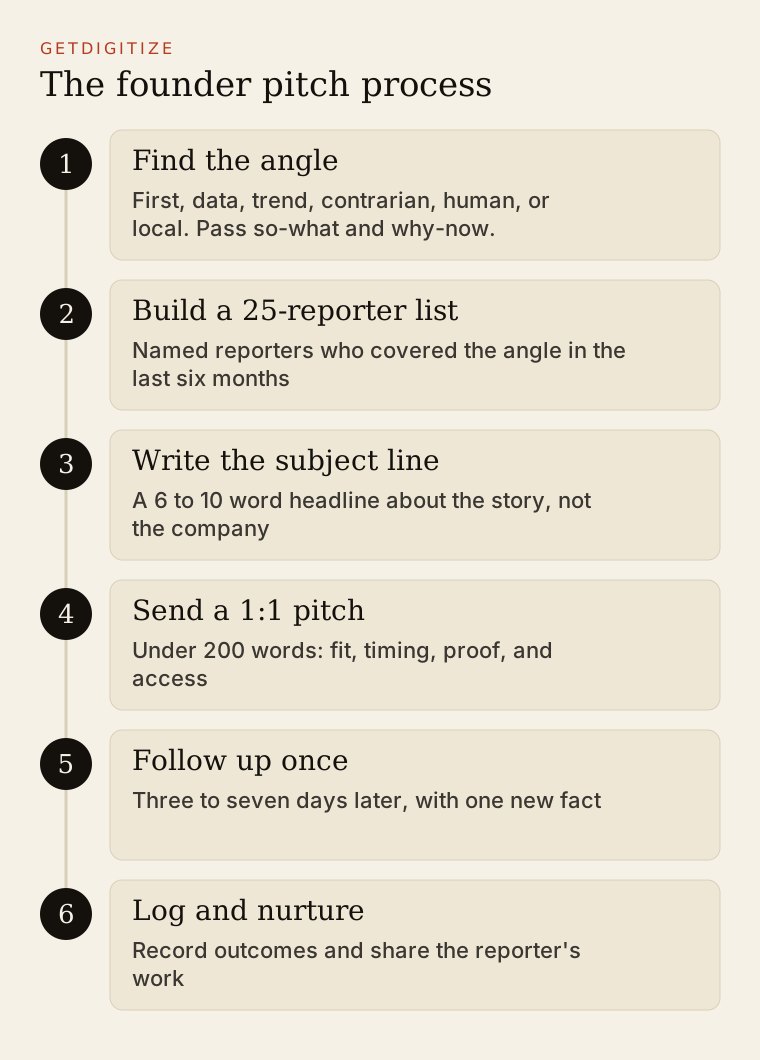
Step 1: How do you find a newsworthy angle?
You find an angle by asking what is new, surprising, or useful to a reader who has never heard of your company. “We launched” is an event. “Restaurant groups are cutting food waste by weighing trash bins, and here is what 40 kitchens learned” is a story. The company becomes the evidence, not the headline.
Most founder stories fit one of six angle types. Pick one before you write anything.
| Angle type | What it sounds like | Example for a Seed to Series B startup |
|---|---|---|
| First or only | ”The first X to do Y” | First payroll tool built for tipped hospitality workers in all 50 states |
| Data | ”We looked at N records and found…” | Anonymized usage data showing when small clinics actually book appointments |
| Trend | ”A shift is happening, here is proof” | Why mid-size HVAC companies are moving off paper dispatch |
| Contrarian | ”Everyone assumes X, the evidence says Y” | Why most AI note-takers increase, not reduce, meeting time |
| Human | ”A person with a stake in the problem” | A founder who ran a dental practice for ten years and built the tool she needed |
| Local or community | ”This affects people where you live” | A Sacramento startup hiring 40 people from a closing plant |
Then run two tests. “So what”: would a reader outside your industry care after one sentence? “Why now”: is there a news peg (a raise, a regulation, a season, a new dataset) that makes it timely? If either fails, fix the angle, not the wording.
If you are struggling to find the one idea worth pitching, the discipline in the 3-2-1 sales strategy helps: one core claim, two proof points, one ask.
Step 2: How do you build a reporter list?
Build a list of 20 to 30 named reporters who have covered your angle in the last six months, and record why each one is a fit. A short, researched list outperforms a mass blast because every email can reference something the reporter actually wrote.
- Start from the story, not the outlet. Search Google News for the angle’s key phrases and note who wrote the recent pieces.
- Check the beat is current. Read each reporter’s last five bylines; beats change often.
- Mix tiers. A trade publication story often lands first and makes the national pitch more credible.
- Find the right address. Many reporters publish a work email or tip line; a media database saves time if you pitch often.
- Write one line per reporter: “Covered X on [date], fits because Y.” If you cannot write it, cut the name.
A simple tracking sheet is enough:
| Reporter | Outlet | Recent relevant piece | Why this story fits | Pitched | Follow-up | Status |
|---|---|---|---|---|---|---|
| Name | Outlet | Title, date | One sentence | Date | Date | Replied / Pass / No reply |
Step 3: How do you write a pitch subject line?
Write the subject line as a compressed headline: the story, not the company, in roughly 6 to 10 words. The reporter should be able to picture the article from the subject alone. Avoid “Press release,” “Partnership opportunity,” all caps, and fake reply prefixes such as “RE:”.
| Weak subject line | Stronger subject line | Why it works |
|---|---|---|
| Exciting news from Acme! | Exclusive: Acme raises $8M to fix restaurant payroll | Names the news, the amount, the problem |
| Story idea for you | Data: small clinics book 38% of visits after 6 pm | Leads with the finding (use your real number) |
| Expert available | HVAC founder on the heat-pump rebate backlog | Ties the expert to a live news topic |
| Partnership opportunity | For your food-waste series: 40 kitchens, 6 months of data | Shows you read their work |
Put the reporter’s first name in the greeting, not the subject line. Spelling a name wrong in the subject is one of the pet peeves journalists raised in Muck Rack’s 2025 State of Journalism webinar.
Step 4: Use these three pitch templates
Each template below stays under 200 words, which matters: in Muck Rack’s 2025 survey, 69% of journalists said they prefer pitches under 200 words. Replace every bracket, and delete any sentence you cannot back with a fact.
Template 1: The launch pitch (offered as an exclusive)
Use this for a product launch or funding round when one well-matched outlet is worth more than ten brief mentions. For the full timeline around a raise, see our playbook on how to announce a funding round.
Subject: Exclusive: [Company] [does specific new thing] for [audience]

Hi [First name],

Your piece on [specific article, date] noted that [problem they wrote about].
[Company] is launching [product] on [date] to fix that for [audience]:
[one sentence on what it does, in plain words].

Why it matters now: [news peg, e.g. new regulation, season, market shift].

Proof: [one hard number, e.g. 60 pilot customers, 14,000 shifts processed],
and [customer name/role] can speak on the record about [result].

I would like to offer you the exclusive, embargoed until [date, time, time zone].
Available: interview with [founder name], customer contact, product images,
and the pilot data.

Would that work for you?

[Name]
[Title, Company] | [phone]
Why it works: the first line proves you read their work. The news peg answers “why now.” The exclusive and the embargo give the reporter a reason to act, and the list of assets shows the story is ready to write. Note what is missing: adjectives, a company history, and attachments.
Template 2: The data story pitch
Use this when you have anonymized data, a survey, or an analysis that says something new about your market. Original data is one of the things reporters say they value most, and it is the pitch type most likely to be cited later.
Subject: Data: [surprising finding in under 10 words]

Hi [First name],

We analyzed [N records / N customers / N months] of [data type] and found
[the single most surprising finding, with the number].

Two more findings that may interest your readers:
- [Finding 2, with number]
- [Finding 3, with number]

Method: [one sentence: sample, time period, how it was collected].
The full dataset and charts are ready to share, and [founder or analyst]
can walk you through it.

Happy to send the full report under embargo until [date], or share it
now if it fits a piece you are working on.

[Name]
[Title, Company] | [phone]
Why it works: the finding is the subject line and the first sentence. The method line pre-empts the reporter’s first question. Keep the company name out of the finding; the data should stand on its own.
Template 3: The expert commentary pitch
Use this when news breaks in your space and your founder can add informed, quotable context. It is the lowest-effort pitch to send and often the fastest route to a first mention.
Subject: [Founder name] on [breaking news topic]: [one-line view]

Hi [First name],

Following today's news on [event], [Founder name], CEO of [Company]
([one line of relevant credibility]), can speak to [the specific angle
most coverage is missing].

Her view in brief:
"[One or two quotable sentences with a clear, defensible opinion.]"

She is available today until [time, time zone] by phone or video,
and can share [supporting data or example] on the record.

[Name]
[Title, Company] | [phone]
Why it works: it arrives while the story is live, includes a usable quote so the reporter can judge the source instantly, and states availability in hours, not “sometime this week.” Send it within hours of the news, not days.
How often should you follow up with a journalist?
Follow up once, three to seven days after the first email, and add something new rather than asking “did you see my email?” In Muck Rack’s 2025 survey, 50% of journalists said one follow-up is ideal and 51% recommended following up within three to seven days. Journalists in the same session said repeated nudges get pitches deleted.
A useful follow-up template:
Subject: RE: [original subject]

Hi [First name], one addition in case it is useful: [new fact, customer,
data point, or image]. Still happy to set up time with [founder] before
[embargo or news date]. If this is not a fit, no need to reply.

[Name]
After one follow-up, silence is an answer. Do not call unless invited, do not chase on social media, and if an exclusive goes unanswered, tell the first reporter before offering it elsewhere. Log every outcome: a “not for me, try my colleague” reply is a win.
What gets you ignored or blocked by journalists?
Irrelevance gets you ignored, and repeated irrelevance gets you blocked. Beyond that, these habits damage a founder’s reputation with a newsroom:
| Habit | Why it backfires | Do this instead |
|---|---|---|
| Mass BCC blasts with a mail merge name | Reporters can tell, and it signals no research | One-to-one emails to a researched list |
| Pitching the company, not a story | Gives the reporter nothing to write | Lead with the angle and the reader |
| Attachments on first contact | Filters flag them; nobody opens them | Offer assets, or link to a newsroom page |
| Brochure language | Reads as advertising | Plain words, one hard number |
| Multiple follow-ups, calls, DMs | Feels like pressure | One follow-up with new information |
| Breaking an embargo or exclusive | Burns the relationship for years | Put terms in writing and keep them |
| AI-drafted pitches sent unedited | Generic and sometimes factually wrong | Use AI for research, write the pitch yourself |
That last point matters more each year. Muck Rack’s 2026 report found 82% of journalists use at least one AI tool, and reporters are increasingly screening pitches with it too. We cover what that means in how journalists use AI to vet pitches. The short version: vague, generic pitches are now easier to filter out.
Tone matters as well. A pitch is a soft sell by nature; our guide to soft sell vs hard sell techniques explains why pressure lowers response rates in every channel, not only with reporters.
How founders, local operators, and D2C brands should adapt their pitching
The process above works for anyone, but the best angle and target list depend on who you are.
Seed to Series B founders. Your strongest early assets are the founder’s expertise and your product data. Start with commentary pitches (Template 3) in your category’s trade press to build a clip file, then use the launch or funding pitch (Template 1) for the one moment each year that deserves an exclusive. Pair pitching with bylines and podcasts so reporters can see a consistent point of view; our guide to landing bylines as a founder covers that track. Our founder PR programs are built around this sequence.
Multi-location local operators. Your best reporters are metro desks, business journals, and local TV. Use the “local or community” angle: hiring, openings, seasonal safety advice, or service data for your region. A dental group’s marketing lead can pitch appointment trends by neighborhood; an HVAC company can offer a technician for heat-wave coverage.
D2C consumer brands. Commerce and shopping editors work on product roundups, gift guides, and trend stories, often months ahead. Pitch the problem your product solves, include price and high-resolution images in the body, and offer samples. Data pitches (Template 2) work well when you can share purchase trends by season or region.
Why pitching still matters for AI search visibility
When ChatGPT, Perplexity, or Google AI Overviews answer “what are the best payroll tools for restaurants,” the answer is shaped by what trusted third parties have written. A data story in a respected trade outlet can keep earning AI citations long after the news cycle ends. So treat each placement as an asset: publish the underlying data on your site, link to the coverage from a newsroom page, and reuse the quotes on LinkedIn.
Your next step: pick one angle from the table above, write the “so what” and “why now” in one sentence each, and build a list of 20 reporters who covered that angle recently. If you want a team to run the list building and outreach with you, our media relations service does exactly that.
Frequently asked questions
How long should a pitch to a journalist be?
A pitch should usually be under 200 words. In Muck Rack’s 2025 survey, 69% of journalists said they prefer pitches under 200 words. In practice that means a subject line that states the story, one sentence that shows you know the reporter’s work, two or three sentences on the story and why it matters now, one proof point, and a clear offer of an interview or data.
What is the best time to pitch a journalist?
Send pitches on weekday mornings in the reporter’s time zone, and avoid major news days. Muck Rack’s 2026 journalist survey found 78% prefer pitches sent before noon (summary via University of Minnesota). Timing matters less than relevance, though: a well-aimed pitch sent at 3 pm beats a generic pitch sent at 9 am. For breaking news commentary, speed within hours matters most.
Should I offer a journalist an exclusive?
Offer an exclusive when you have genuine news, such as a funding round or launch, and one outlet whose readers are exactly your audience. An exclusive gives that reporter first rights, usually under an embargo, in exchange for a more in-depth story. Offer it to one reporter at a time, set a reply deadline, and move to your next choice only after telling the first reporter.
Is it OK to pitch journalists on LinkedIn or X?
Email is the safer default. Journalists in Muck Rack’s 2025 webinar said they monitor email primarily and that social pitches are often missed. Use LinkedIn or X to follow reporters, read their work, and share their stories thoughtfully, so your name is familiar when your email arrives. Send a direct message only if the reporter explicitly invites pitches there.
Do I need a press release to pitch a journalist?
No. The pitch email is what gets attention; a press release is a reference document. Cision’s 2025 survey found 72% of journalists still cite press releases as the most useful resource PR teams can offer, so have one ready for a launch or funding round. Link to it or offer it in the pitch rather than pasting it in or attaching it.