product seeding
Product Seeding for D2C Brands: Get Products in the Right Hands
By Maya Patel · · 13 min read
A product seeding strategy is a planned program of sending free product to people whose opinion your buyers trust (editors, creators, and community voices) without paying for a guaranteed post. You trade certainty for credibility: some recipients will ignore the box, but the ones who post do it because they like the product, and that honesty is what sells.
For a D2C brand doing $500K to $10M a year, seeding is often the cheapest way to get your first wave of real creator content, your first editor who has actually used the product, and the raw material for paid social that does not look like an ad. This guide walks through how we build seeding programs for consumer brands: who goes on the list, what goes in the box, how to ask, how to stay on the right side of the FTC, and how to turn the posts you earn into ads that convert.
What is product seeding?
Product seeding is gifting product to selected people with no contractual obligation to post, review, or mention it. The recipient decides whether the product earns a mention. That separates seeding from a paid influencer deal, where you buy specific deliverables on a specific date.
Seeding sits inside earned media. If you want the broader frame, our guide to what earned media is and why it compounds explains why unpaid, third-party mentions carry more weight with buyers (and with AI search tools) than anything you publish yourself. Seeding is simply one of the most direct ways to create the conditions for those mentions.
Product seeding vs paid influencer deals: what’s the difference?
The difference is control versus credibility. A paid deal guarantees a post, a date, and approved messaging. Seeding guarantees nothing, but the posts you do get read as genuine recommendations, and they cost you only product and shipping.
| Product seeding | Paid influencer deal | |
|---|---|---|
| What you pay | Product, packaging, shipping | Fee (flat, per post, or commission) plus product |
| Post guaranteed? | No | Yes, per contract |
| Messaging control | None, the creator says what they think | Brief and approval rounds |
| Typical hit rate | Varies widely by fit and outreach quality | Contracted deliverables |
| Best use | Discovery, first content, editor familiarity | Launch dates, specific claims, scale |
| Disclosure | Often still required (see below) | Always required |
| Content rights | None unless you license later | Negotiated in the contract |
Most D2C brands need both. Seeding finds out who genuinely likes the product; paid deals scale the creators who already proved it. We usually run seeding first and let the results decide who gets a paid offer, a process we cover in detail in how to find and vet micro-influencers who actually sell.
How do you build a product seeding list?
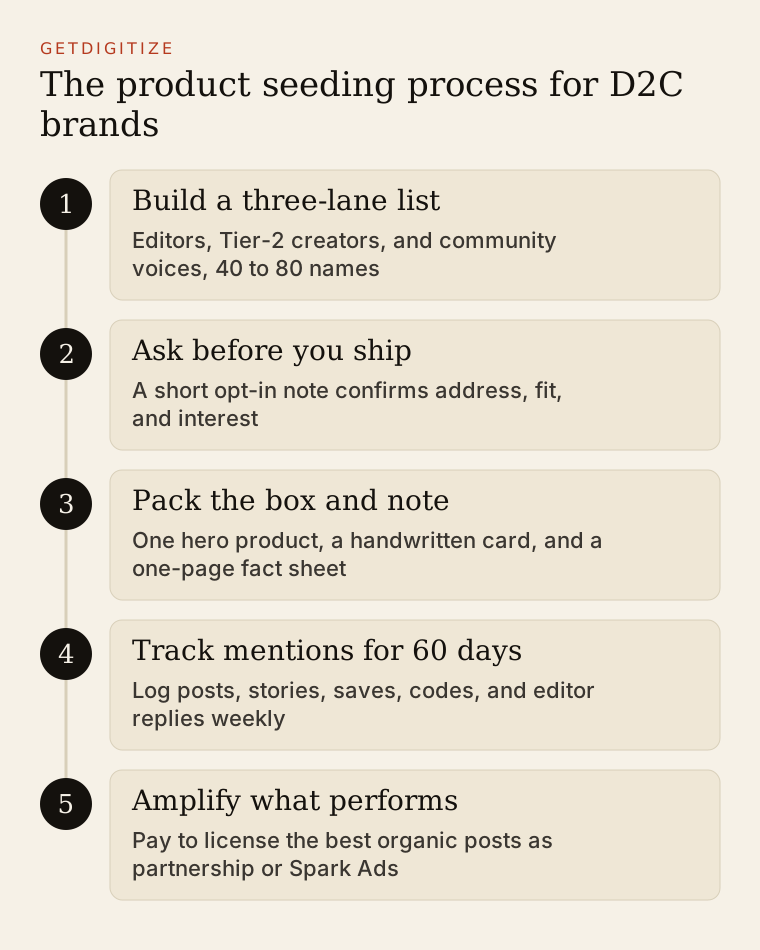
Build the list in three lanes, because each lane does a different job. A first round of 40 to 80 names is enough for most brands to learn what works without burning a quarter of inventory.
Lane 1: Editors and writers
These are the people who write roundups, reviews, and gift guides at outlets like Allure, The Strategist, and Apartment Therapy, plus the freelancers who contribute to them. You are not asking for a story. You are putting the product in their bathroom, kitchen, or gym bag so that when a relevant roundup comes up in three months, they have an opinion. Find them by reading the last six months of roundups in your category and noting the bylines. Editors who have lived with a product for a season are far more likely to include it in holiday coverage, which is why seeding in spring feeds gift guide placements in the fall.
Lane 2: Tier-2 creators (10K to 500K followers)
This is where most D2C seeding budgets should go. Creators in this range are big enough to move units and small enough that a thoughtful package still gets noticed. Look for creators whose audience matches your buyer, who already post about your category unprompted, and whose comments read like real people asking real questions. Skip anyone whose feed is wall-to-wall sponsored posts; a gifted product disappears in that feed.
Lane 3: Community voices
These are the people who shape opinion without a big following: subreddit regulars, Facebook group admins, niche newsletter writers, stylists, estheticians, trainers, and your own most vocal customers. They rarely post polished content, but their recommendations travel in the places buyers go to check whether something is worth it. They also produce the kind of candid, first-hand mentions that feed word-of-mouth marketing.
A simple list tracker
Keep one sheet with these columns: name, lane, handle or outlet, audience fit (1 to 5), why this person, opt-in status, ship date, product and shade or size, follow-up date, posted (yes or no), link, notes. The “why this person” column is the one that matters. If you cannot write one specific sentence, they do not make the list.
Should you ask before you ship?
Yes. Ask first. An opt-in note confirms the address, checks that the product fits (skin type, dietary needs, home size), and signals respect for the recipient’s space. Unsolicited boxes are more likely to be ignored, regifted, or posted in an “unboxing the PR haul” video that does your brand no favors.
Here is an opt-in note you can adapt. Keep it under 100 words.
Subject: Can we send you [product]?
Hi [first name],
I’m [name] from [brand]. We make [one-line description]. I’ve been following your posts on [specific topic or recent post], and I think [product] could fit how you [specific use].
Would you like one? No post expected, we just want it in the hands of people who care about [category]. If yes, reply with your shipping address and [shade, size, or preference].
Either way, thanks for the work you put into [specific thing].
[Name]
For editors, shorten it further and add one fact they can use later: the price, the retailer, and the one thing that makes the product different.
What should go in a seeding package?
A seeding package should contain one hero product, a short personal note, and a fact sheet. More is not better. A box stuffed with tissue, confetti, and six SKUs creates waste, costs more to ship, and makes it harder for the recipient to remember what you actually make.
What to include:
- One hero product in the right shade, size, or variant (you asked in the opt-in, so use the answer).
- A handwritten or personally signed note that references why you picked them.
- A one-page fact sheet: price, where to buy, key ingredients or materials, how to use it, and the founder story in two sentences.
- A contact line: one email address for questions, samples for a friend, or high-res images.
- Optional: a personal discount code they can share if they choose to post. Make it clear it is optional.
Packaging should be recognizable on camera but easy to open and recycle. If your product is fragile, test the box by shipping one to yourself.
A seeding note you can copy
Hi [first name],
This is [product]. We made it because [one sentence founder reason].
I picked it for you because [specific reason tied to their content]. Use it for a couple of weeks and see what you think. No post needed, and honest feedback is welcome.
If you do share it, please mention it was gifted. Your code [CODE] gives your audience [offer] if that’s useful.
[Name], [title], [email]
Notice the note asks for disclosure. That is not a legal formality you can skip; it protects the creator and you.
No-strings vs light-ask seeding: which should you use?
Use no-strings seeding for editors and for first contact with creators, and light-ask seeding for creators who have already opted in and shown interest. The difference is whether you make any request at all.
- No-strings seeding means you send the product and ask nothing. It is the right default for editors, who generally cannot accept conditions on coverage, and for creators you are meeting for the first time.
- Light-ask seeding means you make a soft, non-binding request: “If you like it, we’d love a story tag,” or “Would you be open to sharing honest thoughts in the next month?” It lifts post rates but makes the gift feel more transactional, and it strengthens the case that the relationship needs disclosure.
Never frame a light ask as a condition. The moment a post is required in exchange for the product, you are in a paid deal (product as payment), and you should treat it as one, with a written agreement and a clear brief.
Do seeded posts need FTC disclosure?
Often, yes. The FTC’s Disclosures 101 for Social Media Influencers tells creators that if a brand gives them free or discounted products and they then mention one of its products, they should disclose it, even if they were not asked to mention that product. The disclosure should sit with the endorsement itself, be hard to miss, and not rely only on a platform’s built-in tool.
The FTC’s Endorsement Guides FAQ adds nuance: a free sample handed out to all customers in a store is not an issue, but the key question is whether knowing the product was free could affect how much weight followers give the review. For targeted gifting to a creator with an audience, it usually could. The same FAQ says advertisers need “reasonable programs in place to train and monitor members of their network,” which means your brand, not just the creator, is expected to act.
In practice, that means four things:
- Ask for disclosure in the note. “Gifted” or “gifted by [brand]” in the caption or on the video is simple and clear.
- Do not script claims. If a creator makes a health, efficacy, or results claim you could not substantiate yourself, ask them to correct it.
- Check posts as they go live and politely follow up if disclosure is missing.
- Keep records of who received what and when.
For a fuller treatment of disclosure, honest claims, and fake-follower rules, see our guide to ethical considerations in influencer marketing.
How do you track seeding results?
Track for 60 days after delivery, because creators and editors post on their own schedule. Log every mention in your tracker weekly and measure the round on three levels.
| What to track | How | What it tells you |
|---|---|---|
| Post rate | Posted / delivered, by lane | Whether your list and note are working |
| Content quality | Saves, shares, and comment questions per post | Which creators’ audiences actually care |
| Sales signal | Code redemptions, UTM clicks, spikes in branded search | Who moves units, not just views |
| Editor follow-through | Replies, sample requests, later roundup inclusions | Long-tail earned media from lane 1 |
| Reusable assets | Posts worth licensing | Your pipeline for paid amplification |
Search the platforms directly for your brand name and product name, not just your tags; many creators forget to tag. Set up a saved search or a social listening alert for misspellings too.
How do you turn organic seeding posts into paid ads?
License the best-performing organic posts and run them as ads from the creator’s handle. On Meta, this is done through partnership ads, which Meta describes as ads that feature both the advertiser and the partner account in the header and use signals from both accounts; the creator grants permission at the post level or the account level. On TikTok, the equivalent is Spark Ads, where the creator generates an authorization code for a specific video in the app and shares it with you.
A workable amplification sequence:
- Wait for organic proof. Pick posts with above-average saves, shares, or code redemptions for that creator.
- Offer a licensing fee. Seeding did not buy usage rights. Pay a fair, flat fee for a defined window (for example, 30 or 60 days) and put it in writing.
- Request the code or permission. Spark Ads authorization codes and partnership ad permissions both come from the creator.
- Test small. Run each licensed post against your best brand-made ad with a modest budget and the same audience.
- Scale winners and convert the creator. A creator whose gifted post also wins as a paid ad is your strongest candidate for an ongoing paid partnership.
Once money changes hands, the relationship is plainly material, so the ad and any future posts need clear disclosure.
How D2C brands should run a first seeding round
For a D2C brand, the first round is a learning exercise. Here is a realistic plan for a brand with one hero SKU and a small team.
- Weeks 1 to 2: Build the three-lane list (about 15 editors, 40 creators, 15 community voices). Write the “why this person” line for each.
- Week 3: Send opt-in notes. Expect many not to reply; send one follow-up after five business days.
- Week 4: Ship to everyone who opted in. Confirm delivery.
- Weeks 5 to 12: Track weekly. Thank everyone who posts, whether the post is glowing or mixed.
- Week 12: Review post rate by lane, cost per post, and code redemptions. License two to five posts for paid tests. Offer paid partnerships to the creators whose content sold.
Budget realistically. Product cost, packaging, and shipping are the obvious lines; the hidden cost is staff time for list building and follow-up, which is where most seeding programs fall apart. Seeding also compounds: editor familiarity feeds later press, creator posts feed ads, and a steady stream of third-party mentions helps AI search tools and Google understand what your brand is known for.
If you want a team to build the list, handle outreach, and run the tracking, our influencer and celebrity management service runs seeding programs end to end, and our page for D2C brands shows how seeding fits with editorial press and paid creator work. Either way, the next step is the same: open a sheet, write down 20 names, and write one honest sentence about why each one should get your product.
Frequently asked questions
How much product should a D2C brand set aside for seeding?
Plan for one unit per recipient plus a small buffer for replacements and editor requests. A first round of 40 to 80 recipients is enough to learn which lanes and creators respond without committing a large share of inventory. Count packaging, shipping, and staff time in the budget too, because list building and follow-up usually cost more than the product itself.
What is a good response rate for product seeding?
There is no reliable universal benchmark, because post rates depend heavily on list quality, product category, and whether recipients opted in first. Measure your own baseline in round one, broken out by lane. Opt-in lists, specific personal notes, and genuine audience fit consistently do better than mass unsolicited mailers, so improve those before you send more boxes.
Do creators have to disclose gifted products?
Usually, yes. The FTC tells creators to disclose when a brand gave them free or discounted product and they mention the brand, and to place the disclosure with the post so it is hard to miss. Brands are also expected to train and monitor their creator networks, so ask for “gifted” in your note and check posts as they go live.
When should you seed products before a launch or holiday?
Seed three to six months before the moment you care about. Editors and creators need weeks to use a product before they form an opinion, and holiday roundups are planned in summer. Seeding in spring gives editors time to live with the product before gift guide season, and gives you time to license the best creator posts before peak ad costs.
Can you run seeded creator posts as ads?
Yes, with the creator’s permission and a separate licensing agreement. Seeding does not include usage rights. On Meta, creators grant permission for partnership ads; on TikTok, they generate a Spark Ads authorization code for a specific video. Pay a fair fee for a defined window, and make sure the ad carries a clear disclosure.