micro-influencers
How to Find and Vet Micro-Influencers Who Actually Sell
By Maya Patel · · 12 min read
To find micro-influencers who actually sell, start with your own customers and the creators who already talk about your category, then vet each one on audience fit, comment quality, fake-follower signals, and past brand work before you pay anyone. Follower count tells you reach. It does not tell you whether a creator’s audience buys.
For a D2C brand doing $500K to $10M a year, a handful of well-chosen creators with 10K to 500K followers can outsell a single expensive macro post, and they produce content you can reuse in ads. The hard part is telling a creator with a trusting, buying audience from one with inflated numbers and a feed full of sponsorships. This guide gives you tier definitions, discovery methods, a vetting scorecard you can copy, brief and contract basics, pricing models, and a way to measure sales rather than views.
What is a micro-influencer?
A micro-influencer is a creator with a mid-sized, engaged following, most commonly defined as about 10K to 100K followers on a single platform. The definitions are industry conventions, not official categories, and they vary by agency and platform, but most teams use something close to this:
| Tier | Typical follower range | Strengths | Watch out for |
|---|---|---|---|
| Nano | 1K to 10K | High trust, low cost, often product-only | Small reach; more coordination per sale |
| Micro | 10K to 100K | Niche authority, active comments, fair pricing | Quality varies widely |
| Mid-tier | 100K to 500K | Reach plus niche credibility, polished content | Higher fees, more sponsored posts |
| Macro | 500K to 1M | Broad awareness | Weaker niche trust, higher fraud exposure |
| Mega | 1M+ | Mass reach, celebrity effect | Cost; sales often hard to attribute |
We treat 10K to 500K as the Tier-2 sweet spot for D2C brands. It spans micro and mid-tier creators: big enough to move units, small enough that the audience still treats recommendations as advice from someone they know.
Brands are moving in this direction. Influencer Marketing Hub’s Influencer Marketing Benchmark Report 2026, based on more than 600 respondents, found that about 53% of respondents planned to increase or start using micro creators, while under 8% planned to use fewer.
How do you find micro-influencers?
Find micro-influencers by working outward from your customers: people who already buy and talk about your product first, then creators your customers follow, then creators in adjacent niches. Cold discovery through tools comes last, because it produces the most volume and the least proven fit.
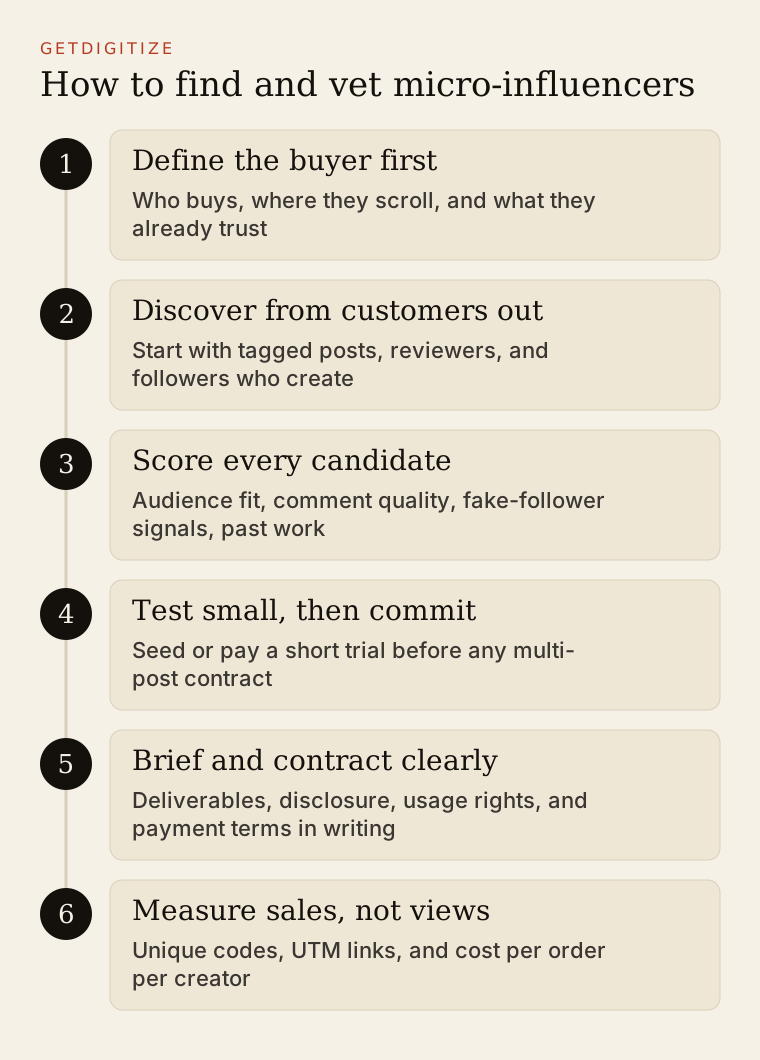
1. Define the buyer before you search
Write two sentences about who buys your product and where they spend time online. “Women 28 to 40 with sensitive skin who follow dermatologists and skincare educators on Instagram and TikTok” produces a better creator list than “beauty influencers.” If you have survey or quiz data from customers, use it; our guide to zero-party data covers how to collect it.
2. Start with your own customers
- Tagged posts and mentions on Instagram and TikTok. Anyone who posted about you unpaid is a warm lead.
- Product reviews on your site and marketplaces. Reviewers who write detailed, photo-rich reviews often create content elsewhere.
- Your followers. Sort by those who have public creator accounts in your niche.
- Customer email list. Ask directly: “Do you create content about [category]? Reply and tell us where.”
3. Map who your customers follow
Look at the accounts your best customers and existing creator partners follow and engage with. Patterns show up quickly: the same few educators, reviewers, or hobbyists appear again and again.
4. Use platform search and hashtags
Search the problem, not your brand: “routine for sensitive skin,” “small apartment storage,” “dog allergy food.” Filter for recent posts with real conversations in the comments. Save creators who make the kind of content you would want to run as an ad.
5. Use discovery tools and marketplaces last
Creator marketplaces and influencer databases speed up search by filtering on follower count, location, and category, and a social listening tool can surface who is talking about your category. Treat tool results as a long list to vet, not a shortlist to hire.
How do you vet micro-influencers? (scorecard)
Vet each creator with a written scorecard so decisions do not rest on vibes or follower counts. Audience authenticity deserves special attention: in the same Influencer Marketing Hub 2026 report, fake or bot followers made up 56.5% of all fraud and quality issues respondents reported, and only 10.9% reported no fraud concerns at all.
Score each area 1 to 5, and weight the total. Anyone below 3 on audience fit or authenticity is out, regardless of the total.
| Criterion | Weight | What a 5 looks like | Red flags |
|---|---|---|---|
| Audience fit | 30% | Audience demographics and location match your buyer; content focuses on your category | Audience mostly outside your shipping countries; topic drift |
| Comment quality | 20% | Specific questions (“does this work on oily skin?”), creator replies, repeat commenters | Generic emojis, “nice pic,” comments unrelated to the post |
| Authenticity | 20% | Steady follower growth; engagement consistent across posts | Sudden follower spikes, many empty or foreign bot accounts, likes far above comments |
| Past brand work | 15% | Some sponsored posts, clearly disclosed, that look like their normal content | Feed dominated by ads; competitors promoted last month; missing disclosures |
| Content quality | 10% | Content you would run as an ad; clear demos; good audio and light | Only static brand-supplied photos |
| Professionalism | 5% | Replies promptly, has a media kit, shares analytics when asked | Refuses to share audience data or screenshots |
How to check for fake followers
Ask for screenshots of platform analytics (audience location, age, gender, and reach for the last 30 days) directly from the app. Then check these signals yourself:
- Growth pattern. Big overnight jumps without a viral post are a warning sign.
- Engagement ratios. Compare likes to comments and views to followers across 10 to 15 recent posts. Wild swings deserve a question.
- Follower sample. Open 20 to 30 followers. Accounts with no posts, no profile photo, and random handles in large numbers suggest purchased followers.
- Comment sample. Read the comments on three recent posts. Real audiences ask questions and argue; bots repeat themselves.
Buying fake influence is also a legal problem, not just a waste of money. In August 2024 the FTC announced a final rule that bans selling or buying fake indicators of social media influence, such as bot-generated followers or views, when the buyer knew or should have known they were fake and uses them for commercial purposes.
Check past brand work
Scroll back 90 days. Note how many posts are sponsored, whether disclosures are clear, whether sponsored posts perform close to organic ones, and whether the creator has recently promoted a direct competitor. A creator whose sponsored posts get a fraction of the engagement of organic posts has an audience that tunes out ads.
What goes in a micro-influencer brief and contract?
A brief tells the creator what you need and why; a contract fixes what you are buying. Keep the brief to one page and let the creator own the creative. Micro-influencers sell because they sound like themselves.
A one-page brief you can copy
Brand and product: [Name], [one-line description], $[price]
Why we chose you: [one specific sentence about their content]
Goal: Drive first purchases from [audience]. We measure orders through your code and link.
Key message (pick one): [the single benefit you want understood]
Must include: Your honest experience after [X] days of use; clear disclosure (“ad” or “paid partnership” at the start of the caption and in the video); your code [CODE] and link.
Please avoid: [claims you cannot substantiate, e.g., “cures,” “clinically proven” unless provided], competitor mentions, [anything else].
Deliverables and dates: [1 Reel or TikTok + 3 Stories], draft by [date], live by [date].
Contact: [name, email, phone]
Contract basics
Put these in writing for every paid partnership, even small ones:
- Deliverables: format, number, platform, and live dates.
- Approval: one review round for accuracy and disclosure, not rewrites.
- Disclosure: the creator uses clear disclosure plus the platform’s paid partnership label.
- Usage rights: whether you can repost or run the content as ads, on which platforms, and for how long (for example, 30, 60, or 90 days). Price this separately.
- Exclusivity: a short, category-specific window if you need one, and pay for it.
- Payment: amount, model, and timing (for example, 50% at signing, 50% after posting).
- Claims and compliance: the creator only makes claims you provide or can substantiate.
The FTC’s Endorsement Guides FAQ says advertisers need “reasonable programs in place to train and monitor members of their network,” including explaining what claims they can make, instructing them on disclosure, and checking what they post. For more detail, see our guide to ethical considerations in influencer marketing.
How much do micro-influencers charge?
Micro-influencer pricing varies widely by platform, niche, deliverables, and usage rights, so treat any published rate card as a rough starting point. What you can control is the pricing model.
| Model | How it works | Best for | Risk |
|---|---|---|---|
| Product only (gifting) | Free product, no required post | Nano creators, first contact | Low post rate; see product seeding |
| Flat fee | Fixed payment per deliverable | Clear launches, specific dates | You carry all the performance risk |
| Commission (affiliate) | Percentage of sales via code or link | Creators with proven buying audiences | Creators may decline or deprioritize |
| Hybrid | Lower flat fee plus commission | Most D2C programs | Needs clean tracking |
| Usage and whitelisting fees | Extra payment to run content as ads | Top-performing posts | Easy to underprice; set a time limit |
A hybrid model usually works best for D2C. The flat fee respects the creator’s time, and the commission rewards the ones whose audiences buy. Start new creators with a small test (one post or a gifted trial) before signing multi-month deals.
How do you measure micro-influencer sales, not views?
Measure each creator on orders and cost per order, using a unique discount code and a tracked link for every creator. Views and likes show the content was seen; only orders show it sold.
This is where many programs fall short. Influencer Marketing Hub’s 2026 report found that among brands planning budget increases of 50% or more, brand awareness was the most selected KPI (89%), while conversions (35%) and attributable revenue (25%) lagged well behind. Awareness matters, but a D2C brand paying creators needs to know which ones pay back.
Set up tracking before any post goes live:
- Unique code per creator (for example, JADE15), so sales are credited even when viewers type the code at checkout.
- UTM-tagged link per creator for link-in-bio, Stories, and newsletters.
- A simple post-purchase survey (“Where did you hear about us?”) to catch sales that bypass the code.
- A weekly tracker with creator, fee, product cost, orders, revenue, cost per order, and new versus returning customers.
Then compare creators on the same terms:
| Creator | Total cost | Orders (30 days) | Revenue | Cost per order | Keep? |
|---|---|---|---|---|---|
| Creator A | $[fee + product] | [#] | $[x] | $[cost / orders] | Renew, license best post |
| Creator B | $[fee + product] | [#] | $[x] | $[cost / orders] | Test one more format |
| Creator C | $[fee + product] | [#] | $[x] | $[cost / orders] | End |
Allow for halo effects: some creators drive branded search and direct traffic that codes miss. Our guide to measuring PR ROI and earned media value covers how to account for that without inflating results.
How D2C brands should build a micro-influencer program
For a D2C brand, the goal is a small bench of creators who reliably sell, not a big roster that looks good in a deck. A practical first quarter:
- Month 1: Build a long list of 50 to 100 creators, starting from customers and tagged posts. Score them and cut to 20.
- Month 2: Seed the 20 or run small paid tests with 8 to 10 of them. Use unique codes and links from day one.
- Month 3: Rank by cost per order. Offer ongoing hybrid deals to the top three to five, and license their best posts as ads.
Repeat each quarter, adding new creators to the test pool and retiring ones who do not perform. Time one test round for late summer so your best performers are briefed before holiday season, when creator gift lists run alongside editorial gift guides. Over time, the program also creates a steady stream of third-party mentions that feed word of mouth, editorial interest, and AI search visibility.
If you want help building the list, vetting creators, and running the tracking, our influencer and celebrity management service runs Tier-2 creator programs for consumer brands, and our page for D2C brands shows how creator work fits with editorial press. Either way, your next step is simple: pull every post that tagged your brand in the last 90 days and score the first ten creators on the scorecard above.
Frequently asked questions
How many followers does a micro-influencer have?
A micro-influencer usually has about 10K to 100K followers on a single platform, though definitions vary by agency and platform. Nano-influencers sit below that at roughly 1K to 10K, and mid-tier creators run from about 100K to 500K. For D2C brands, we treat 10K to 500K as the most useful range because it combines niche trust with enough reach to sell.
What is the fastest way to find micro-influencers in your niche?
The fastest way is to start with people already talking about your brand: tagged posts, detailed reviewers, and followers who run creator accounts. Then look at who your best customers follow and search your category’s problems on Instagram and TikTok. Discovery tools help with volume, but warm leads from your own audience are usually quicker to vet and more likely to sell.
How can you tell if an influencer has fake followers?
Check for sudden follower spikes without a viral post, likes far out of proportion to comments, generic or repetitive comments, and large numbers of followers with no photos or posts. Ask for analytics screenshots from the app showing audience location and reach. The FTC bans knowingly buying fake followers or views for commercial purposes, so authenticity is a legal issue as well as a performance one.
Should you pay micro-influencers with product only?
Product-only deals work for nano creators and first contact, but they should not carry required deliverables. If you require a post, you are buying content and should pay a fee or commission under a written agreement. Most D2C brands get the best results from a hybrid model: a modest flat fee plus a commission on tracked sales.
What should you measure in a micro-influencer campaign?
Measure orders, revenue, and cost per order for each creator, using a unique discount code and a UTM-tagged link. Add a post-purchase survey to catch sales that skip the code. Views and engagement are useful secondary signals for content quality, but renewals and ad licensing decisions should be based on which creators actually drive purchases.