7c framework
What Is the 7C Framework of Digital Marketing? The 7 Cs Explained
By Marcus Chen · · Updated · 8 min read
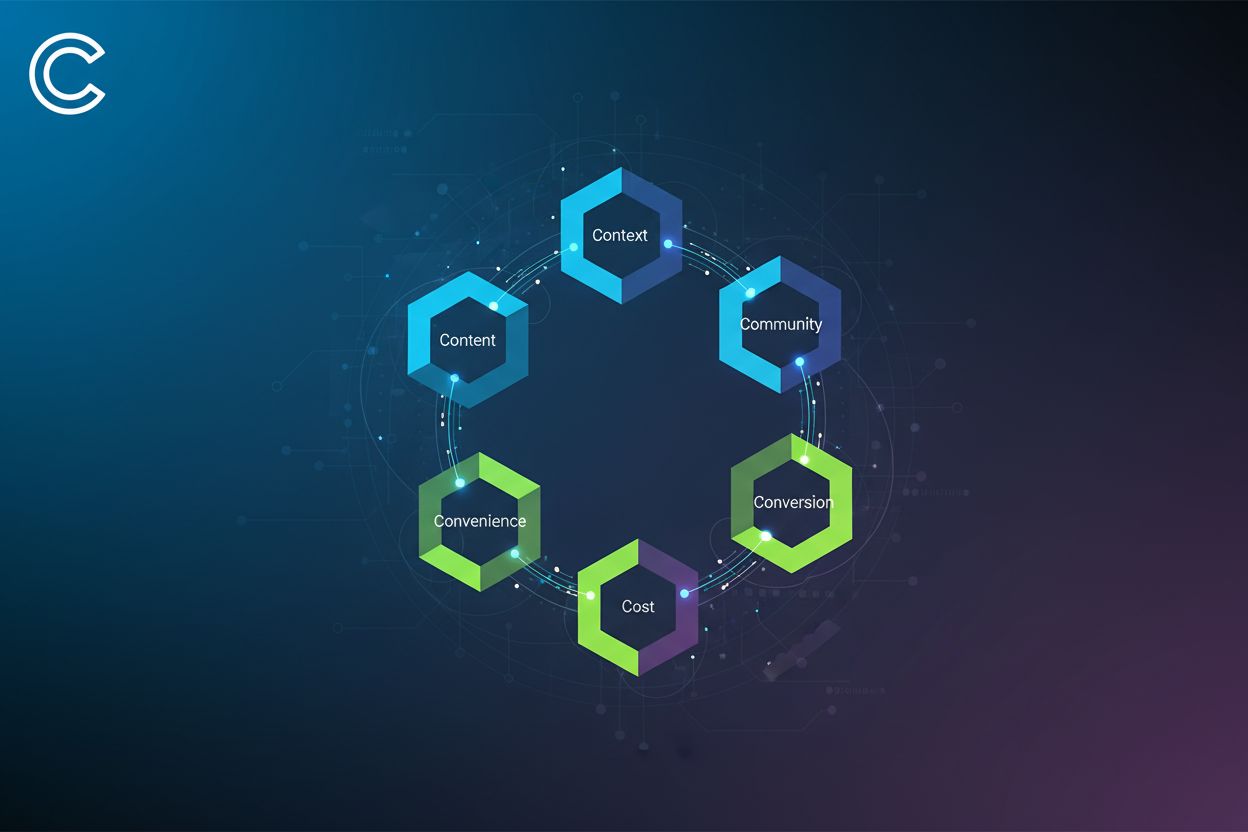
The 7C framework of digital marketing is a checklist of seven areas every digital presence needs to get right: Customer, Content, Context, Community, Convenience, Communication, and Commerce. It started as a model for designing e-commerce websites and now works as an audit tool. It matters because a weak spot in any one C, such as a clumsy checkout or silent social channels, undercuts the other six.
What is the 7C framework?
The 7C framework is a way to evaluate a brand’s digital presence from the customer’s side, one area at a time. Instead of asking “which channel should we add,” it asks whether a buyer can find useful content, get answers, feel part of a community, and buy without friction.
The idea traces back to the 7Cs of the customer interface, which Jeffrey Rayport and Bernard Jaworski set out in their e-commerce textbooks around 2001. Their list (Context, Content, Community, Customization, Communication, Connection, Commerce) described the design elements of a website, and academic researchers still use it as a reference model, for example in this International Journal of Electronic Commerce study. Marketers later adapted it into a broader digital marketing checklist that puts the Customer first and adds Convenience.
The version most digital marketing guides use today:
| C | The question it asks | Signs it is weak |
|---|---|---|
| Customer | Do we know who we serve and what they need? | Generic messaging, personas nobody uses |
| Content | Do we publish things our buyers actually want to read, watch, or cite? | Thin blog posts, no original data or opinions |
| Context | Does the message fit the device, place, and moment? | Desktop-only pages, the same ad everywhere |
| Community | Do customers talk to us and to each other? | No reviews, no replies, no user content |
| Convenience | Is it easy to find, compare, and buy? | Slow mobile pages, long forms, hidden pricing |
| Communication | Do we answer and start conversations across channels? | Unanswered DMs, slow email replies |
| Commerce | Does the experience turn interest into revenue? | Traffic with few conversions or bookings |
Why are there different versions of the 7 Cs?
Different versions exist because the 7 Cs has been adapted many times, and no single authority owns the list. Rayport and Jaworski’s original focused on website design. Later authors swapped letters to match their priorities:
- Customization (original list): tailoring the site or offer to each user.
- Connection (original list): links to and from other sites, which today maps to backlinks and brand mentions.
- Conversion: turning visitors into leads or customers.
- Consistency or Cohesion: keeping the brand experience uniform across channels. The agency DevriX, for example, uses a list with Cohesion and Conversion in place of Communication and Commerce in its guide to implementing the 7 Cs.
- Credibility: proof that the brand is trustworthy, such as reviews and press coverage.
The letters matter less than the discipline. Pick one list, define each C for your business, and score against it the same way every quarter.
What does each of the 7 Cs mean in practice?
Each C is a lens for one part of the buyer’s experience. Here is what to look at for each.
Customer
The Customer C means knowing who you serve well enough to predict what they search for, which objections they raise, and where they spend time. Build this from real inputs: sales call notes, support tickets, review text, and search queries, not from assumptions in a planning meeting. Every other C depends on this one, which is why it comes first.
Content
The Content C covers everything you publish: articles, videos, product pages, guides, and social posts. Good content answers a buyer’s actual question better than anyone else does. It also needs something original, such as a point of view, a process, or data you own, because AI assistants and search engines favor sources that add new information.
Context
The Context C is about fitting the message to the situation: device, location, time, and stage of the buying process. A salon customer searching “haircut near me” on a phone at 5 p.m. needs hours, a booking link, and directions, not a brand video. Context also includes platform norms: what works on LinkedIn reads differently on TikTok.
Community
The Community C is the set of conversations that happen around your brand, both with you and between customers. Reviews, comment threads, user-generated content, forums, and creator posts all count. A strong community produces the third-party proof that new buyers look for and that AI answer engines draw on.
Convenience
The Convenience C measures how easy it is to find, evaluate, and buy from you. Fast mobile pages, visible pricing, short forms, clear navigation, and multiple ways to pay or book all belong here. Convenience problems are often invisible to the team that built the site, so test with someone who has never used it.
Communication
The Communication C covers two-way contact: replying to reviews and DMs, answering emails, running live chat, and starting conversations through newsletters or social. The standard buyers expect is a real response from a real person within a reasonable time. Silence on a public complaint is itself a message.
Commerce
The Commerce C is where the experience turns into revenue: purchases, subscriptions, booked appointments, or qualified leads. Look at conversion rates by channel, cart or form abandonment, and the steps between intent and payment. If the other six Cs are strong and Commerce is weak, the problem is usually friction or a mismatch between promise and offer.
How do you run a 7C audit?
You run a 7C audit by scoring each C on a simple scale, backing each score with evidence, and fixing the lowest score first. A practical process:
- Choose your list. Use the seven Cs in the table above unless your team already uses another version.
- Gather evidence for each C. Pull analytics, review counts and ratings, response times, page speed results, and a sample of recent content.
- Score each C from 1 to 5. One person scores, a second person checks. Write one sentence of evidence per score.
- Find the weakest link. The lowest score is your first priority, because a single weak C can cancel out strong work elsewhere.
- Set one fix per C with an owner and date. For example: “Reply to all new reviews within two business days” (Communication) or “Cut the booking form from nine fields to four” (Convenience).
- Re-score every quarter. Track the trend, not just the snapshot.
How does the 7C framework compare to other marketing frameworks?
The 7C framework audits the digital experience, while most other frameworks either plan strategy or map the buyer’s path. They work well together:
| Framework | Main use | Best paired with the 7Cs when |
|---|---|---|
| 7C framework | Auditing your digital presence area by area | You need to find what is weak today |
| 5 C’s of marketing | Situation analysis before planning | You are setting strategy and need market context first |
| 5 A’s framework | Mapping the customer path from Aware to Advocate | You need to know which buying stage loses people |
| 4 or 5 P’s | Defining the marketing mix | You are shaping the offer, price, and distribution |
How should founders, local operators, and D2C brands use the 7 Cs?
The 7 Cs apply to any business, but each type of company tends to have a different weakest link.
Seed to Series B founders are usually weak on Content and Community. A young company has little original content and few independent voices talking about it. A founder who publishes a clear point of view, earns a few trade press articles, and appears on relevant podcasts builds both at once, and those mentions also shape how ChatGPT and Perplexity describe the company.
Multi-location local operators such as dental groups, HVAC companies, and salon chains should look hardest at Context, Convenience, and Communication. Buyers search on phones, want the closest location, and choose based on reviews and whether someone replies. Accurate Google Business Profiles for every location, one-tap booking, and consistent review replies cover all three. Our local business AI visibility guide covers how this also affects AI Overview citations.
D2C consumer brands between $500K and $10M ARR often score well on Content and Commerce but underinvest in Community. Editorial coverage in outlets like The Strategist or Apartment Therapy and honest posts from Tier-2 creators (10K to 500K followers) give shoppers the third-party proof they want before a first purchase.
If Content or Community is your lowest score, earned media is usually the fastest fix, because coverage and mentions build both at once. Our digital marketing, GEO, and SEO service covers the Content, Context, and Convenience side of the audit.
Your next step
Block one hour this week, score your brand on each of the seven Cs with one sentence of evidence each, and circle the lowest score. That single C is your next quarter’s priority. If the gap is in Content, Community, or AI-search visibility, GetDigitize can help with a scoped plan.
Frequently asked questions
What are the 7 Cs of digital marketing?
The 7 Cs of digital marketing are Customer, Content, Context, Community, Convenience, Communication, and Commerce. Together they form a checklist for evaluating a brand’s digital presence from the buyer’s point of view. Some versions replace one or two letters with Conversion, Consistency, Cohesion, Customization, Connection, or Credibility, but the purpose of each version is the same.
Who created the 7C framework?
Jeffrey Rayport and Bernard Jaworski described the original 7Cs of the customer interface in their e-commerce work around 2001. Their list was Context, Content, Community, Customization, Communication, Connection, and Commerce. Marketers later adapted it into the digital marketing version used today, which adds Customer and Convenience to reflect a broader focus on the buyer’s full experience.
What is the difference between the 7 Cs and the 4 Ps?
The 4 Ps (Product, Price, Place, Promotion) define what a company offers and how it takes that offer to market, while the 7 Cs evaluate the buyer’s experience of the brand online. The 4 Ps look outward from the company. The 7 Cs look inward from the customer, which makes them better suited to auditing a website, social presence, and purchase flow.
How often should you run a 7C audit?
Run a 7C audit once a quarter, and again after any major change such as a site redesign, new location, or product launch. Quarterly reviews are frequent enough to catch problems like slow review replies or falling conversion rates before they compound, and infrequent enough that fixes from the previous audit have time to show results.
Which of the 7 Cs matters most?
Customer matters most because every other C depends on knowing who you serve. After that, the most important C is whichever one scores lowest in your audit. A brand with excellent content and a broken checkout loses sales at Commerce, so the weakest area limits the results of all the others.