digital transformation strategy
Digital Transformation Strategy for Small Businesses: A Roadmap
By Daniel Reyes · · Updated · 9 min read

A digital transformation strategy for a small business is a short, prioritized plan to replace the manual, slow, or outdated parts of how customers find you, buy from you, and come back, using affordable tools and measurable goals. It does not need an enterprise budget. It matters because most buying journeys now start on a phone or in an AI assistant, and small teams can adapt faster than large competitors.
Is digital transformation only for big companies?
No, digital transformation works for small businesses, and small teams often have the advantage because they can decide and ship in days instead of quarters. A large hospital network may take years to replace a scheduling system. A three-location physical therapy practice can switch to online booking in a week.
The difference is scope. A small business does not need platform migrations or data lakes. It needs to fix the few processes that cost the most time or lose the most customers:
- One broken process at a time. Fixing how you follow up with new leads is a real win, even if nothing else changes this quarter.
- Habits over subscriptions. A CRM does nothing if the team still tracks leads on sticky notes. Adoption is the goal, not the purchase.
- Customer-facing first. Staff will tolerate a clunky internal tool; customers will not tolerate a clunky booking page.

Research on smaller firms points the same way. The OECD’s 2021 report on the digital transformation of SMEs notes that smaller companies lag in digital uptake because of limited internal resources and awareness, skills gaps, and financing issues. Most of that is a strategy and training problem, and it is fixable.
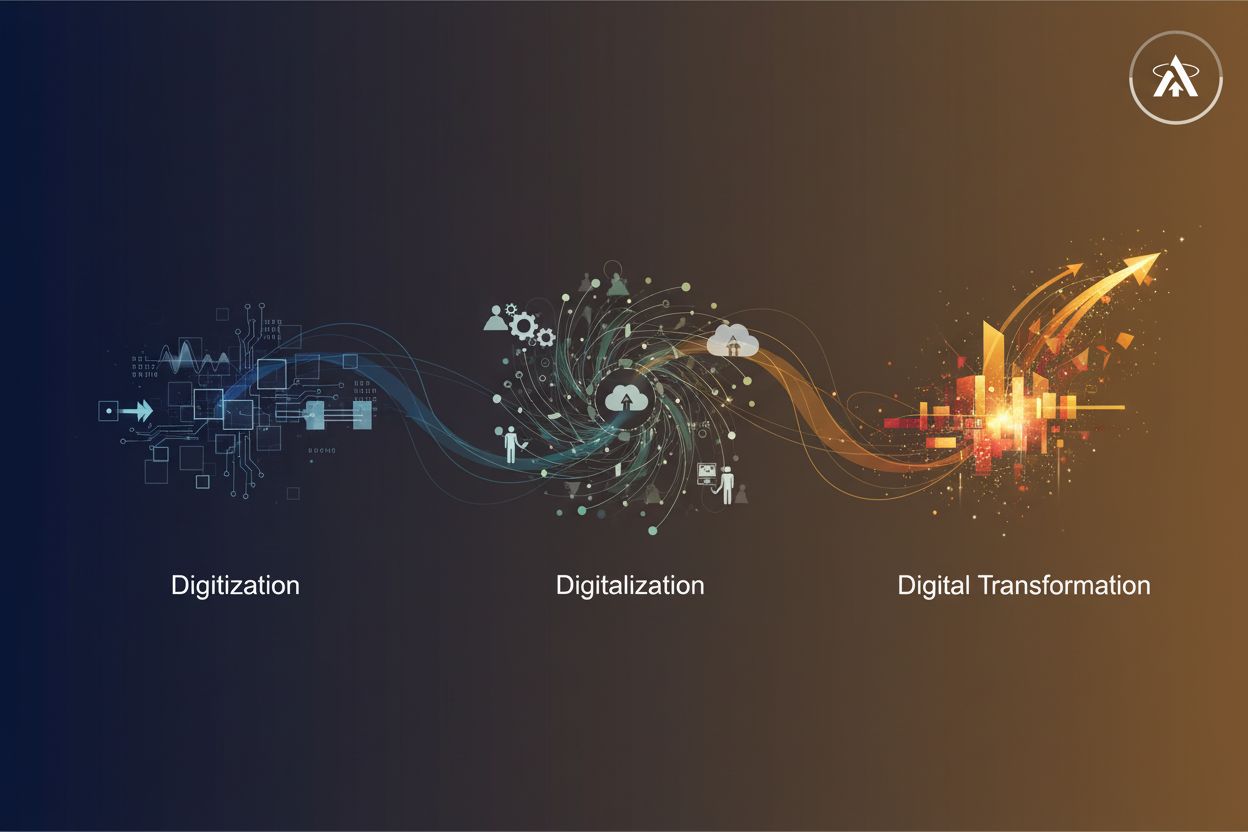
If you are still sorting out the vocabulary, our guide to digitization vs digitalization vs digital transformation explains where each type of project fits.
What are the steps in a small business digital transformation roadmap?
The roadmap has five steps: audit where you are, set brand-first goals, choose a lean tool stack, bring your team along, and measure results against a baseline. Here is the summary, followed by detail on each.
| Step | Key question | Output | Typical timeframe |
|---|---|---|---|
| 1. Audit | Where do customers drop off and where does staff time go? | Current-state map of channels, tools, and data | 1 to 2 weeks |
| 2. Set goals | Which two or three outcomes matter most this year? | Goals with a baseline number | 1 week |
| 3. Choose tools | What is the smallest stack that solves those goals? | Tool list with owners | 2 to 4 weeks |
| 4. Bring the team along | Who uses each tool, and what do they get from it? | Training plan and feedback loop | Ongoing |
| 5. Measure and adjust | Did the numbers move against the baseline? | Monthly or quarterly review | Ongoing |
Step 1: Audit your current state
Start by mapping the customer journey from first search to repeat purchase, and list every tool and spreadsheet involved. Look for three things: where leads go unanswered, where staff re-type data between systems, and where customer and marketing data sits in separate lists that do not match. Those silos are the most common blocker to everything else.
Step 2: Set brand-first goals
Tie each goal to an outcome customers would notice, not an output. “Launch an app” is an output. “Cut the time from inquiry to booked appointment in half” is an outcome. Check that every new tool fits how your brand talks to people. If your business is known for a personal touch, a cold, generic chatbot as the first point of contact works against you.
Consistency matters here. Mixed messages confuse buyers and weaken trust, so your automated emails, invoices, and chat replies should sound like the same company as your website and front desk.

Step 3: Choose a lean tool stack
Pick the smallest set of tools that connect to each other. Too many tools create new silos where the email platform does not talk to the sales tracker. A typical small business stack covers:
- Website and booking or checkout, fast on mobile, with one obvious call to action.
- A CRM that holds every lead and customer conversation.
- Email and SMS automation for welcome, reminder, and follow-up messages written in a human voice.
- A review request and monitoring tool so every happy customer gets asked, and every review gets a reply.
- Analytics that connects traffic and campaigns to calls, bookings, or orders.
Don’t pay for enterprise tiers you will not use for years.
Step 4: Bring the team along
Explain the benefit to each role before you roll anything out. A retail manager who resists a new inventory system usually changes their mind once someone shows them it removes hours of manual counting. Keep training short and hands-on (a short screen recording or a lunch session beats a 50-page manual), and let one or two interested staff members test new tools first and report back.
Boston Consulting Group’s research on digital transformation lists leadership among the six factors that separate successful programs from failed ones. In a small business, that leader is often the owner or location lead, so their visible use of the new system matters.

Step 5: Measure and adjust
Compare results against the baseline you set in Step 2, and cut tools that do not earn their cost. This matters because most digital initiatives miss their targets: a 2024 Gartner survey found that only 48% of digital initiatives meet or exceed their business outcome targets. Regular reviews are how you catch the ones that are not working early.

Which customer-facing basics should you fix first?
Fix mobile experience, the path to booking or buying, and your visibility in search and AI answers first, because those are where customers decide whether to choose you.
- Mobile speed and clarity. Most local and D2C customers find you on a phone. Slow pages and tiny text send them to a competitor. Make the main action (Book, Call, Buy) the most prominent element on the page.
- Accessibility. The WebAIM Million report found detectable accessibility failures on the vast majority of the top one million home pages. Fixing contrast, alt text, and form labels helps real customers and sets you apart.
- Search and AI visibility. Consistent business listings, location pages, schema markup, and answer-first content help Google and AI assistants understand and recommend you. Our local business AI visibility guide covers the checklist.
- Content that answers questions. Short, specific pages and posts that answer what customers actually ask connect your tools to your audience.

How do you measure whether your digital strategy is working?
You measure it by tracking business outcomes (bookings, orders, calls, repeat customers) against your starting baseline, not vanity metrics like likes or impressions. Useful measures for a small business:
- Conversion: percentage of site visitors who book, call, or buy.
- Speed to lead: time from inquiry to first response.
- Adoption: share of customers using the new portal or booking option versus calling in.
- Reputation: review volume, average rating, and response rate.
- Visibility: Map Pack position, organic traffic, and whether AI assistants mention you for your core services.
What does this look like for local operators, D2C brands, and founders?
The roadmap is the same, but the first priority differs by business type.
Multi-location local operators. For a dental group, HVAC company, or salon brand with 3 to 15 locations, start with per-location essentials: accurate listings, online booking, call tracking, and an automated review request after every visit or job. Those feed Map Pack rankings and AI Overviews directly. Once those basics run smoothly, a new location or community program gives you a reason to pursue local news coverage, which adds the third-party mentions AI assistants look for. See how we approach this on our local business page.
D2C brands. Start with checkout speed on mobile, post-purchase email flows, and a review collection system, then connect order data to your press and creator activity so you can see what drives repeat buyers. Our D2C brand page covers the earned media side.
Seed to Series B founders. Keep the stack small and invest in the public layer: a clear website, answer-first content, and credible coverage that search engines and AI assistants can cite when investors and customers research you.
For the broader definition, pillars, and common pitfalls, read our overview of what digital transformation is.
What should you do next?
Block two hours this week to map one customer journey, from first search to paid or booked, and mark every manual step and drop-off point. Choose the single fix customers would notice most, set a baseline number, and ship it within 30 days before starting the next one.
Frequently asked questions
How much does digital transformation cost for a small business?
The cost depends on scope, but most small businesses can start with tools they already pay for or low-cost subscriptions for booking, CRM, email, and reviews. The larger cost is usually staff time for setup and training. Start with one high-impact process, measure the return, and fund the next step from what that first fix saves or earns.
Where should a small business start with digital transformation?
A small business should start with an audit of the customer journey, then fix the step where the most customers drop off. For most local operators that is booking or lead follow-up. For most D2C brands it is mobile checkout or post-purchase email. Starting with a visible, customer-facing fix builds momentum and makes the value obvious to the team.
What is a business digitization roadmap?
A business digitization roadmap is a sequenced plan that moves a company from manual or paper processes to digital and automated ones, with goals, owners, and timelines for each step. It usually covers an audit, goal setting, tool selection, team training, and measurement. For a small business it should fit on one page and be reviewed monthly or quarterly.
Why do small business digital projects fail?
Small business digital projects usually fail because the team does not adopt the new tools, the goals were never defined, or too many disconnected tools were bought at once. Technology is rarely the problem. Explaining the benefit to each role, training in short sessions, and measuring against a clear baseline prevent most failures.