ai share of voice
AI Share of Voice: How to Measure Your Brand in AI Search
By Marcus Chen · · 13 min read
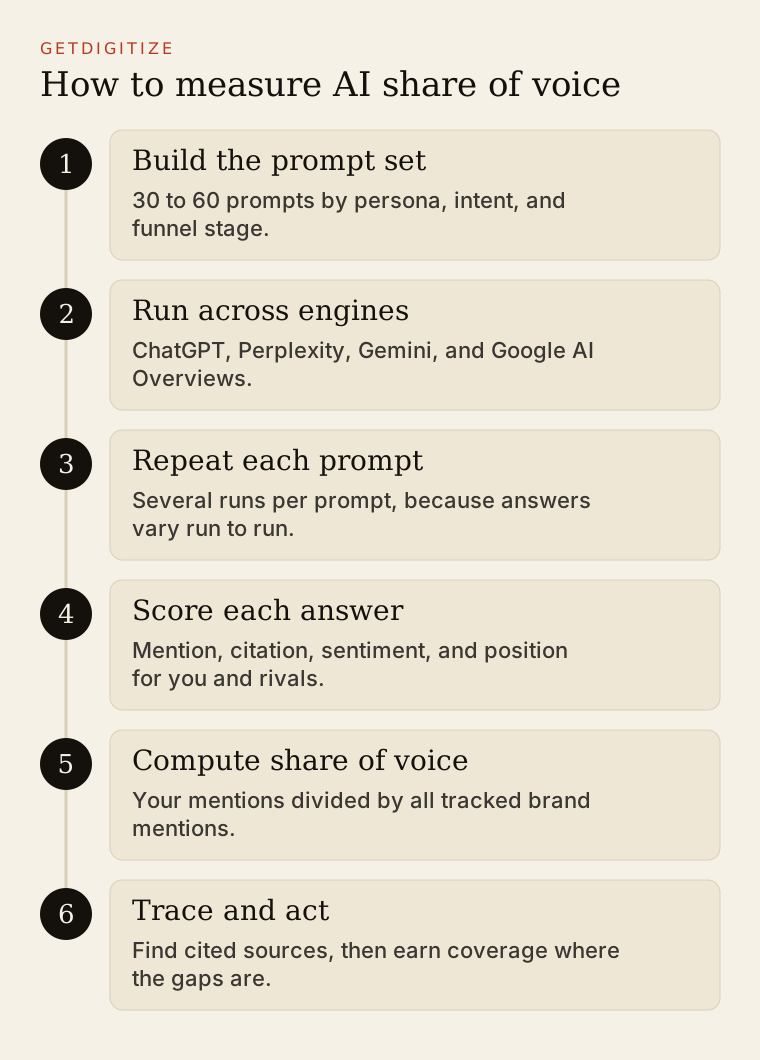
AI share of voice is the percentage of brand mentions in AI-generated answers that belong to your brand, measured across a fixed set of buyer prompts on tools like ChatGPT, Perplexity, Gemini, and Google AI Overviews. It tells you how often AI assistants recommend you compared with competitors when buyers ask about your category, which classic share of voice and rank tracking cannot show.
This guide explains how to build a prompt set, run it across engines, score each answer, set a cadence, and act on the results. It is written for three kinds of teams we work with: Seed to Series B founders who need to show up when investors and buyers ask an assistant about their category, multi-location local operators who want to be the dentist or HVAC company an assistant names, and D2C brands whose customers increasingly ask “what’s the best” before they ever search.
What is AI share of voice?
AI share of voice is your brand’s share of all tracked brand mentions across a defined set of prompts and AI engines, over a set time period. If assistants mention five brands a combined 200 times across your prompt set and your brand accounts for 50 of those mentions, your AI share of voice is 25%.
The formula:
AI share of voice = (your brand mentions ÷ total mentions of all tracked brands) × 100
Most teams also track a simpler companion number, mention rate: the percentage of answers that mention you at all. Mention rate tells you whether you are in the conversation. Share of voice tells you how much of the conversation you own relative to the brands you compete with.
Why does classic share of voice miss AI answers?
Classic share of voice misses AI answers because it measures media mentions, social mentions, or paid impressions, and none of those record what an assistant says when a buyer asks for a recommendation. An AI answer is a private, generated response. It does not appear in a media database, a social listening feed, or a rank tracker.
Three differences matter:
- There is no fixed results page. A search engine results page is roughly stable for a query. AI answers are not. In a SparkToro study published January 30, 2026, Rand Fishkin and Gumshoe.ai ran 12 prompts through ChatGPT, Claude, and Google’s AI 2,961 times. The same brand list came back less than 1% of the time, and the same list in the same order less than 0.1% of the time. The researchers found that how often a brand appears across many runs was far more consistent than its position, which is why frequency, not rank, is the core metric.
- The answer is shaped by what the model reads. AI tools summarize sources. Your share of voice depends on whether the publications, review sites, and forums they cite mention you.
- Google’s own traffic reporting blends AI in. Google’s guidance on AI features confirms that clicks from AI Overviews and AI Mode are included in overall Search Console traffic under the “Web” search type. You can’t isolate AI answer visibility from your existing reports, so you have to measure it directly.
| Classic share of voice | Rank tracking | AI share of voice | |
|---|---|---|---|
| What it counts | Media, social, or ad mentions | Position of your URL for a keyword | Brand mentions inside AI answers |
| Unit of measure | Articles, posts, impressions | Rank 1 to 100 | Percentage of answers and mentions |
| Stability | Fairly stable month to month | Stable day to day | Varies run to run, needs repeats |
| Tells you | Media and social visibility | Organic search visibility | Whether assistants recommend you |
| Main input | PR, content, ad spend | SEO | Earned media, entity data, reviews, content |
How do you build a prompt set for AI share of voice?
Build a prompt set by listing the personas who buy from you, the questions each asks at each stage of buying, and the exact phrasing a real person would type into an assistant. Aim for 30 to 60 prompts. Fewer than 30 makes the number jumpy; more than 60 becomes expensive to run by hand.
Structure it as a grid: personas down the side, intents across the top.
| Intent | What it looks like | Why it matters |
|---|---|---|
| Category discovery | ”What are the best [category] for [use case]?” | The list you most need to be on |
| Comparison | ”[Your brand] vs [competitor]: which is better for [need]?” | Shows how assistants frame you against rivals |
| Problem-led | ”How do I fix [problem your product solves]?” | Tests whether you appear before buyers know brands |
| Local | ”Best [service] near [city or neighborhood]“ | Critical for multi-location operators |
| Brand check | ”What is [your brand]? Is it legit?” | Tests accuracy and sentiment, not share |
Keep brand-check prompts out of the share of voice calculation (you will always be mentioned in answers about yourself), but score them for accuracy and sentiment.
A sample prompt set you can copy
Here is a starter set for three different companies. Swap in your category, city, and competitors.
Seed-stage B2B founder (expense management software):
1. What are the best expense management tools for startups under 50 people?
2. Which corporate card is best for a seed-stage startup?
3. Alternatives to [market leader] for small teams
4. How do I stop employees from submitting duplicate expense reports?
5. [Your brand] vs [competitor] for a remote team
6. What is [your brand] and who founded it?
Multi-location dental group (Sacramento area):
1. Best dentist in Roseville for families
2. Who does same-day crowns near Folsom, CA?
3. Emergency dentist open Saturday in Sacramento
4. Which dental offices in Elk Grove take Delta Dental PPO?
5. Is [your practice] a good dentist? What do reviews say?
D2C skincare brand:
1. Best vitamin C serum for sensitive skin under $40
2. What moisturizer do dermatologists recommend for rosacea?
3. Clean skincare brands that actually work for acne
4. [Your brand] vs [competitor] retinol: which is gentler?
5. Best skincare gifts for someone who has everything
Write prompts the way a customer types, not the way a marketer writes. If you have call transcripts, sales notes, or site search logs, pull phrasing from them. The same research techniques behind AI keyword research work here, with the difference that you want full questions, not two-word keywords.
Which AI engines should you track, and how do you run the prompts?
Track the four engines your buyers most likely use: ChatGPT, Perplexity, Gemini, and Google AI Overviews (plus AI Mode if it shows for your queries). Each draws on different sources and cites them differently, so a brand can lead on one and be missing on another.
A few rules keep the data clean:
- Repeat each prompt. Because answers vary, run each prompt at least three to five times per engine per measurement cycle and average the results. The SparkToro researchers ran 60 to 100 repetitions per prompt; you don’t need that many to track a trend, but one run per prompt is not a measurement.
- Use logged-out or clean sessions. Personalization and chat memory skew results. Use a fresh session or a dedicated account with memory off.
- Hold location constant. Local answers change by location. Run local prompts from the city you are measuring, or state the city in the prompt.
- Record the full answer and every citation. You will need the cited URLs later to figure out why a competitor wins.
- Note model and date. Engines update models often. A jump in your number could be a model change, not your work.
Citation behavior differs by engine. Muck Rack’s May 2026 analysis of more than 25 million links found ChatGPT cites sources in 96% of responses but averages about five citations each, Gemini cites in 82% of responses with about eight, and Claude cites in 55% but averages 13 when it does. That means you’ll have far more citation data to work with from some engines than others.
You can run this by hand in a spreadsheet for a 30-prompt set, or use a monitoring tool once the process is stable. We compare the options in the best AI visibility monitoring tools.
How do you score each AI answer?
Score each AI answer on four dimensions: mention, citation, sentiment, and position. Mention drives the share of voice math; the other three tell you about the quality of that visibility and why it is or isn’t happening.
| Score | Question | Values |
|---|---|---|
| Mention | Is the brand named in the answer? | 1 = yes, 0 = no |
| Citation | Is one of your own URLs cited as a source? | 1 = yes, 0 = no |
| Sentiment | How is the brand described? | +1 positive, 0 neutral, -1 negative |
| Position | Where in the answer is it named? | 1 = first, 2 = top three, 3 = later |
Count each brand once per answer, and score every tracked competitor on the same sheet, not just yourself. Share of voice only exists relative to others.
A scoring sheet template
Copy these columns into a spreadsheet, one row per answer:
Date | Engine | Model | Prompt ID | Persona | Intent | Run # | Brand | Mentioned (0/1) | Cited own URL (0/1) | Sentiment (-1/0/1) | Position (1/2/3) | Top cited sources | NotesThen build a summary tab with these calculations per engine, persona, and intent:
- Mention rate = answers mentioning you ÷ total answers
- AI share of voice = your mentions ÷ all tracked brand mentions
- Citation rate = answers citing your URL ÷ answers mentioning you
- Net sentiment = average sentiment across answers that mention you
- Top-three rate = mentions in position 1 or 2 ÷ your total mentions
A worked example: you run 40 prompts, four engines, three runs each, for 480 answers. Across those answers, you and four competitors are mentioned 1,200 times in total. Counting each brand once per answer, your brand appears in 132 answers. Your mention rate is 132 ÷ 480 = 27.5%, and your AI share of voice is 132 ÷ 1,200 = 11%. If the category leader holds 38%, you know the size of the gap, and the source column tells you where it comes from.
Treat position as secondary. Given how much ordering shifts between runs, report it as a rate across many answers, never as a single “rank.”
How often should you measure AI share of voice?
Measure AI share of voice monthly for trend reporting, and run a smaller spot check weekly around launches, funding announcements, or major press. Monthly is frequent enough to catch model changes and slow enough that real shifts show up above the run-to-run noise.
A practical cadence:
- Weekly: 10 priority prompts on two engines, to catch sudden changes
- Monthly: full prompt set, all engines, three to five runs each, with the summary tab updated
- Quarterly: revise the prompt set (add new competitors, retire stale prompts, add new product lines) and report trends to leadership
Keep the core prompt set fixed for at least two quarters. If you change prompts every month, you can’t tell whether the number moved because of your work or your wording.
What moves AI share of voice?
Three inputs move AI share of voice most: earned media in publications AI tools read, clean entity data that tells engines exactly who you are, and review volume and content on the platforms they summarize. Content on your own site matters too, but mostly as the source that gets cited once you are already in the conversation.
Earned media. Muck Rack found that 84% of AI citations come from earned media, journalism alone accounts for 27%, and paid or advertorial content only 0.3%. That has held between 82% and 89% across three editions of the study since July 2025. Separately, an Ahrefs study of 75,000 brands found branded web mentions correlated with AI Overview visibility at 0.664, versus 0.218 for backlinks. The implication is direct: getting written about by the outlets your category relies on is the most reliable lever. We cover the mechanics in brand mentions vs. backlinks for AI citation and how to get cited by ChatGPT and Perplexity.
Entity data. Assistants need to know your brand is a distinct thing with a clear category, founder, and location. Consistent naming across your site, Organization schema, Wikidata where eligible, LinkedIn, Crunchbase, and business profiles reduces confusion with similarly named brands. A Google Knowledge Panel for your brand or founder is a good sign the entity is resolved.
Reviews and community discussion. For local operators and D2C brands, assistants lean on review platforms and forums. Review volume, recency, and the themes in reviews shape how you are described. Reddit threads show up often in citations for product and service questions; our guide to Reddit marketing for AI search covers how to take part without getting banned.
When a competitor beats you on a prompt, open the citations on that answer. If the cited sources are three trade publications, a gift guide, and a Reddit thread, that is your to-do list.
How founders, local operators, and D2C brands should use AI share of voice
Each segment we work with should weight the prompt set and the response differently.
Seed to Series B founders should focus on category-discovery and comparison prompts, since those are the questions investors, candidates, and early buyers ask. Measure before and after a launch or funding announcement: coverage in the tech and trade press from an announcement can surface quickly in engines that search the web live. Pair the program with founder bylines and podcast appearances, which add named, quotable sources.
Multi-location local operators should build prompts per location and report share of voice per city, not in aggregate. A strong flagship location can hide the fact that assistants never name your newer offices. The inputs that matter most are regional press, complete Google Business Profiles, and review volume per location.
D2C brands should weight “best [product] for [need]” and gift prompts heavily, and track sentiment closely, because assistants often summarize common complaints from reviews. Editorial coverage and roundups in publications like The Strategist and Allure, plus creator content, are the inputs to prioritize.
Across all three, pair AI share of voice with the monitoring you already do. It fits alongside AI-driven brand monitoring of social and media mentions, and it becomes the outcome metric for PR work that was hard to tie to results before.
Your next step
Write 30 prompts this week using the grid above, pick three competitors, and run the full set once on ChatGPT and Google AI Overviews with three repeats each. That baseline takes a few hours in a spreadsheet and shows you where you stand. If you want us to build the program and the earned media plan that moves it, see our digital marketing, GEO, and SEO service.
Frequently asked questions
What is a good AI share of voice?
A good AI share of voice is one that beats your share of the market and grows quarter over quarter against the same prompt set. There is no universal benchmark, because the number depends on how many competitors you track and how broad your prompts are. Instead of chasing a benchmark, compare yourself with the category leader on the same prompts, and as a challenger focus on trend and on winning specific personas.
How is AI share of voice different from AI visibility?
AI visibility usually means whether your brand appears in AI answers at all, often reported as a mention rate. AI share of voice is relative: it measures your portion of all brand mentions compared with competitors across the same prompts. You can have rising visibility and falling share of voice if competitors are gaining faster than you.
Can you track AI share of voice for free?
Yes, you can track AI share of voice for free with a spreadsheet and manual prompt runs, which works well for 30 to 60 prompts. The cost is time: several hours per monthly cycle. Paid monitoring tools automate repeated runs, citation capture, and competitor scoring, which becomes worthwhile once the prompt set grows or you track many locations.
How long does it take to improve AI share of voice?
Improving AI share of voice usually takes one to three quarters, depending on the input. Engines that search the web live, like Perplexity and ChatGPT with search, can reflect new press coverage within weeks. Changes that depend on model training data or entity recognition take longer. Measure monthly and judge progress over at least two quarters.
Does paid advertising increase AI share of voice?
Paid advertising has little direct effect on AI share of voice. Muck Rack’s May 2026 analysis found paid and advertorial content accounted for 0.3% of AI citations, while earned media accounted for 84%. Ads can still drive branded search and reviews, which help indirectly, but press coverage, entity data, and reviews are the direct inputs.